Why Kouilou Needed a Hand
October in Congo-Brazzaville means new uniforms, exercise books and, for many households, stretched budgets. In the coastal department of Kouilou, where incomes often rely on seasonal agriculture and informal trade, parents can spend a full week’s earnings on a single child’s supplies, according to local school heads.
With inflation nudging prices upward nationwide, several principals warned that children risk starting classes late or without the right tools, widening achievement gaps. Against that backdrop, Foundation SNPC scheduled its annual educational outreach to coincide with the national reopening week, aiming to ease the first-term crunch.
A Six-Day Tour Across Kouilou
Over six brisk days, a convoy of Foundation SNPC volunteers, teachers and administrative partners criss-crossed dusty laterite roads as well as the newly paved segments of Route Nationale 1 to reach 23 villages and small towns spread between the Loeme river and the Atlantic coastline.
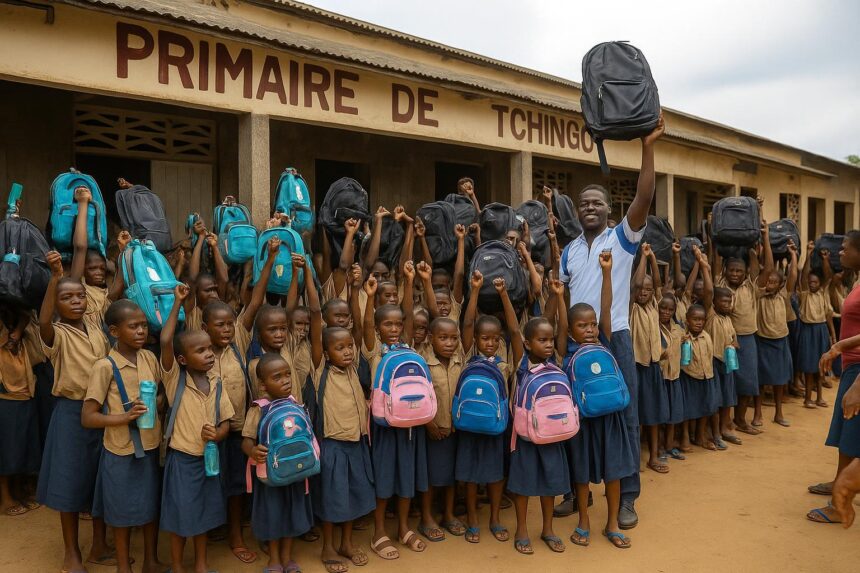
Day one covered Mboubissi Tangoufouana, La Loeme and Siala. The team pushed on to Tchibanda, Tchitondi, Yanga, Mboukou, Tchingoli, Mongo Tandou and Tchikoulou on day two before looping through Tchissoko, Ndebouano, Tchivoula and Hinda Poste as the midway point.
Stops four and five retraced segments to reinforce distribution at Mongo Tandou, Tchingoli and Tchikoulou, then extended toward Nkoungou, Ntandou-Milomba, Nkondi-Mbaka and Mpondila. The final push reached Mengo A, Makola, Mengo B and Hinda, capping a circuit of roughly 370 kilometres.

9,000 Learners, 35 Schools: the Numbers
Foundation SNPC’s logistics desk tallied 9,000 beneficiaries across 35 public primary and secondary schools. Each establishment provided pre-validated enrolment lists to avoid duplication. The operation moved 24 tons of notebooks, exercise pads, pens, rulers, compasses and weather-resistant backpacks stacked earlier in Pointe-Noire warehouses.
A simple calculation shows the delivered stationeries cover at least the first semester, saving families an estimated 9,000,000 CFA francs in combined expenses, according to figures shared by the Kouilou Departmental Directorate of Education that monitored the drop-offs.
Teachers Welcome Timely Relief
‘Many pupils arrive with a single sheet of paper folded in their pocket,’ confessed Ms. Maya Koutimba, head teacher at Tchivoula Primary. ‘This support means I can start lessons immediately instead of spending two weeks improvising with slate boards.’ Her colleagues echoed the sense of regained time.

In science classes, the newly distributed geometry sets allow accurate board demonstrations rather than freehand estimates. Mathematics tutor Firmain Mabiala noted that consistent tools reduce classroom stress: ‘The same protractor for everyone removes excuses and sharpens focus. It’s a quiet revolution, but it is real.’
Parents See Budgets Breathe Again
At the market square in Nkoungou, fish seller Clarisse Ngalula described how the kits freed cash for uniforms. ‘I have four children. Before, I bought a few books each payday. This year, the Foundation arrived first. That difference will pay for shoes and transport,’ she smiled.
Household surveys by the National Institute of Statistics put average monthly income in rural Kouilou at under 80,000 CFA francs. Stationery for several pupils can swallow ten percent of that sum, meaning the project’s ripple effect extends beyond classrooms into family food security.
Aligning With National Education Goals
Congo-Brazzaville’s Education Strategy 2022-2026 lists universal basic supply as a pillar for retaining pupils in remote zones. Regional inspector Lucien Voutila praised the partnership, saying it complements government allocations without overlap. ‘Public-private synergy is essential for Sustainable Development Goal 4,’ he told local radio.
The operation also dovetails with President Denis Sassou Nguesso’s emphasis on human capital in Plan National de Développement 2022-2026. By focusing on disadvantaged districts, Foundation SNPC underscores a shared priority: turning subsurface resources into long-term knowledge deposits for future generations.
Inside the Kits: More Than Stationery
Beyond pens and paper, each backpack carries a leaflet on hygiene habits, including handwashing steps endorsed by the Ministry of Health. A colourful timetable insert reminds learners of the national public-holiday calendar, while a plastic folder protects report cards during the rainy season.

Volunteers demonstrated how to organise books by subject to prevent early wear and sharpen study routines. Small gestures, they argued, anchor the symbolic value of the gift: education as a structured journey rather than a daily improvisation.
Foundation SNPC’s Broader Vision
Created in 2008, Foundation SNPC funds health caravans, water-point rehabilitation and cultural festivals alongside its flagship education drive. Spokesperson Irène Massamba said the board has maintained a ten-percent allocation of annual profits for social programmes despite global oil-price swings.
‘The objective is simple,’ she explained in Hinda. ‘We extract value beneath the soil; we must return value above the soil. School kits are tangible, immediate and measurable.’ Annual reports indicate nearly 70,000 pupils have received assistance since the programme’s launch.
What Comes Next for Students
Foundation teams will conduct monitoring visits in January to measure kit utilisation and dropout rates, using the data to fine-tune next October’s circuit. Meanwhile, pupils of Kouilou start their lessons knowing that, this year at least, paper and pencils will not run out before ideas do.