Brazzaville buzzes for a handball renaissance
For ten late-December nights, the Michel d’Ornano and Maxime Matsima gyms pulsed like sold-out concert halls. The National Cohesion and Fraternity Tournament, run by the movement “Le réveil du handball congolais”, set a festive tempo rarely seen since Brazzaville hosted the 2015 African Games.
- Brazzaville buzzes for a handball renaissance
- Forty-three squads, one shared heartbeat
- Finals night writes fresh folklore
- Beyond medals: rewards that empower
- Congo-RDC bridge strengthened through sport
- Voices from the court and the boardroom
- Next stop Pointe-Noire: momentum rolls on
- Handball’s economic ripple in everyday life
- Looking forward with measured optimism
Families from Moungali to Talangaï queued outside at dusk, drawn by affordable tickets and the prospect of seeing local stars share the floor with guests from Kinshasa and Lubumbashi. “It felt bigger than sport; it felt like our city waking up,” smiled supporter Odile Mayoukou between vuvuzela blasts.
Forty-three squads, one shared heartbeat
A record 43 senior teams—men and women—answered the call, travelling from Pointe-Noire, Dolisie, Nkayi, Madingou, Loutété, Ouesso and two key RDC hubs. Organisers booked modest hostels, fed entire delegations and covered inner-city transport, ensuring no club declined for financial reasons.
Each team, even first-round casualties, departed with a one-million-CFA envelope, an acknowledgment that development starts with dignity. Kinshasa sides secured two million, while Lubumbashi’s emblematic Tout-Puissant Mazembé earned three, reflecting longer and costlier journeys across the Congo River.
Finals night writes fresh folklore
On 22 December the lights dimmed, phones rose and Grain de sel’s women walked out to thunderous drums. Their 23-16 victory over DGSP was built on fast breaks and goalkeeper Justine Loumbo’s 12 saves. “We promised ourselves to run until the last whistle,” she said, medal gleaming.

Moments later the men’s showdown pitted BMC against the crowd-favourite C.F.J.S.O. BMC’s backcourt duo, Nathan Bemba and Armel Bavoueza, combined for 15 goals, sealing a 27-20 triumph. When the final siren rang, blue-and-white scarves flew like confetti across the parquet.
Beyond medals: rewards that empower
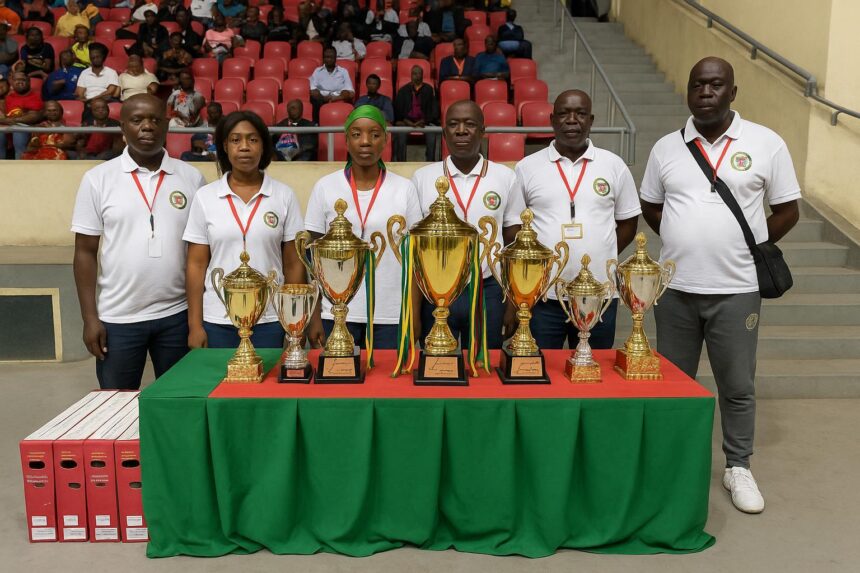
The top three clubs in each category collected trophies, medals, official IHF balls and prize money. Yet eyes widened most at the individual awards: every referee, MVP and top scorer wheeled away a 32-inch plasma screen donated by handball consultant Chérubin Nkodia, a gesture applauded by players still in sweaty jerseys.
Fair-play honours went to Pigeon-Vert de Loutété, Sangha-Sport de Ouesso and Tout-Puissant Mazembé, echoing the tournament logo, “Friendship through Handball”. Each received five extra balls—gold in value for rural training grounds where equipment tears fast.

Congo-RDC bridge strengthened through sport
The decision to invite teams from Kinshasa and Lubumbashi added fresh flavours and derby-level tension. Patrice Kabeya, coach of JSK Kinshasa, whose men finished a proud third, praised the atmosphere: “We battled hard, but supporters here clapped even our best goals. That respect travels home with us.”
Administrators on both banks hint at twinned youth camps next Easter, betting that shared drills and song sessions can outshine any riverine rivalry. In a region where music and football dominate headlines, handball quietly scripts its own diplomacy.
Voices from the court and the boardroom
Tournament coordinator Christelle Colombe Bouaka Milandou closed proceedings by saluting the general of brigade Serge Oboa for steadfast backing. “His commitment reminds us that strong institutions and strong athletes rise together,” she told reporters, framing sport as a lever for national unity.
Players echoed that sentiment. BMC captain Nathan Bemba, still holding the trophy, underlined the ripple effect: “Kids in Diata will see this cup on social media tonight and maybe pick up a ball tomorrow. That is our bigger victory.”
Next stop Pointe-Noire: momentum rolls on
Before the final podium photo, organisers revealed that the next edition will move to Pointe-Noire in February 2026. The coastal city’s renovated Kasia Hall is slated to welcome even more visitors, leveraging its port for streamlined logistics and tourism spin-offs.
Local business councils already discuss bundle deals linking beach stays to late-afternoon matches. If the plan holds, handball could position itself as both sporting asset and weekend getaway catalyst, stimulating small hotels and food vendors along the Atlantic front.

Handball’s economic ripple in everyday life
In Brazzaville the tournament injected brisk cash into moto-taxi riders, snack sellers and jersey printers. City accountant Albert Samba estimated a micro-impact worth “at least 150 million CFA in ten days”, citing packed cafés during televised matches.
Such numbers, while modest beside oil revenue, demonstrate how targeted sporting events diversify urban livelihoods. Combined with government programmes promoting youth employment, they craft a narrative of opportunity rooted in passion and fair competition.
Looking forward with measured optimism
“The wake-up has only started,” insisted coordinator Bouaka Milandou, promising coaching clinics and referee courses before the Pointe-Noire leg. She underlined the need for corporate partners to supply balls and nets year-round so that the sparkle of December does not fade in March.
Handball faithful remain confident. Grain de sel winger Mélanie Ngoma put it plainly: “We have shown that investing in women’s sport pays off. Give us courts, we will fill them.” Her words drew loud applause, a fitting soundtrack to a night of promise.