Early-morning confusion outside Angola Libre
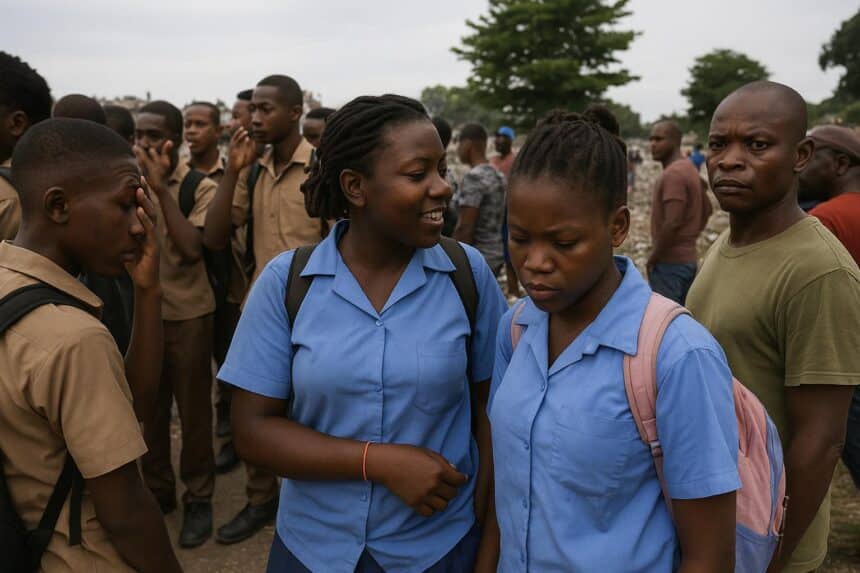
The dawn bell had not yet rung when hundreds of teenagers gathered before the partly demolished walls of CEG Angola Libre in southern Brazzaville. Some clutched photocopied lists, others only their notebooks, all wondering where lessons would resume.
- Early-morning confusion outside Angola Libre
- Two substitute campuses, one timetable headache
- How the information gap fuels absenteeism
- SNPC steps in with temporary structures
- Toward a safer, larger future campus
- Transport and meal costs hit households
- What students and parents should do now
- Community spirit turns challenge into opportunity
- Looking ahead without losing the year
Midway through last week, management announced the temporary relocation of the school’s 5,200 learners, but news travelled unevenly. As a result, the entrance became a live bulletin board, each rumour sending small groups running toward different neighbourhoods.
Two substitute campuses, one timetable headache
According to principal Gervais Sangou, pupils from sixth to ninth grade have been split between the primary school Kongo dia Moukouba and the Auguste Bintsindou college. Emergency wooden classrooms erected by the National Petroleum Company of Congo, SNPC, expand capacity.
Yet class hours remain fluid. At Auguste Bintsindou the morning block is reserved for local enrolments, pushing Angola Libre newcomers to the afternoon slot. ‘We waited three hours at the gate before learning about the shift system,’ sighed Dieuveil Miamonika, a fifth-grader.
How the information gap fuels absenteeism
Several adolescents interviewed by our newsroom admitted they had not seen any allocation list. One, Venacia Koléla, wandered with classmates along Aéroport Avenue in search of directions. ‘People keep telling us to check walls, but the papers get torn or soaked by rain,’ she noted.

Principal Sangou insists the data have been posted since Thursday and urges families to ‘read carefully before midday to avoid crowds’. He fears a cascade of dropouts if learners drift for more than a week, an anxiety shared by local parent associations.
SNPC steps in with temporary structures
On each substitute site, SNPC engineers assembled plywood halls equipped with fans, benches and solar lamps. The oil company says the gesture echoes its social-investment mandate. Construction supervisor Mambouany Nkouka claims twenty classrooms were finished in five days without interrupting nearby lessons.
Parents welcomed the speed but raised concerns about heat and noise. ‘Metal sheets amplify the sun; we hope afternoon periods will be short,’ remarked Jeanne Mavouadi, mother of two. School officials respond that insulation mats and trees will be added this month.

Toward a safer, larger future campus
The Ministry of Primary and Secondary Education confirms that Angola Libre’s original compound, built in the 1970s, had developed structural cracks after last year’s heavy rains. A full demolition followed by a modern, multi-storey complex is planned under the government’s School for All programme.
Engineer dossiers show the forthcoming campus will host 60 classrooms, laboratories, an IT hub and an arts centre, with disability access throughout. The tender should be awarded before December, officials told Radio Congo, while academic activities continue on the two interim sites.
Transport and meal costs hit households
Moving campuses means longer commutes for many families in Makélékélé district. Taxi-bus fares have risen 100 CFA each way, a stretch for small vendors. ‘My daily budget jumps from 500 to 700 CFA,’ calculated pastry seller Alain Massamba, who escorts his niece every morning.
Canteen services are also being reorganised. The ministry has authorised street caterers to operate outside Kongo dia Moukouba under strict hygiene checks. Health inspector Alice Kikaya reports that hand-washing points and price posters will be installed next week to keep meals affordable and safe.
What students and parents should do now
School officials advise checking allocation lists daily at the old campus gate, the mayor’s office and the two host schools. Identification cards are required to enter class. Learners unable to locate their name can call the hotline 5454 for immediate reassignment.
Teachers, meanwhile, have been instructed to repeat core lessons during the first fortnight to ensure nobody falls behind. ‘Our priority is continuity, not speed,’ stressed maths instructor Clarisse Dikambo. Report cards will carry a note indicating any days lost to relocation logistics.

Community spirit turns challenge into opportunity
Despite the setbacks, many pupils celebrate the refurbishment as a long-overdue upgrade. ‘We dream of a library with computers,’ said third-grader Mickael Nguesso. Parent committees are mobilising paint and books for the temporary rooms, turning every recess into a small renovation workshop.
Local NGO Jeunesse Plus has offered after-school tutoring near the city stadium to cushion the transition. Sessions will focus on mathematics and French, with volunteer university students. Registration opened Monday and is free for any child presenting an Angola Libre badge.
Looking ahead without losing the year
Officials insist the relocation, though disruptive, will not derail the academic calendar. Quarter exams are kept on their original dates, and transport subsidies are under study. ‘Every desk we install now lays the groundwork for a stronger school tomorrow,’ summarised Principal Sangou.
For the moment, the youthful crowd outside the torn-down gate walks a daily tightrope between uncertainty and excitement. Each chalked arrow on a wall is both a signpost and a promise: that education in Brazzaville can bend, relocate, even rebuild, yet keep moving forward.
The ministry schedules a mid-year evaluation of the relocation plan, inviting feedback via local councils. Stakeholders hope the exercise will refine emergency protocols for other ageing schools across the Republic.