Flowers, prayer and national gratitude
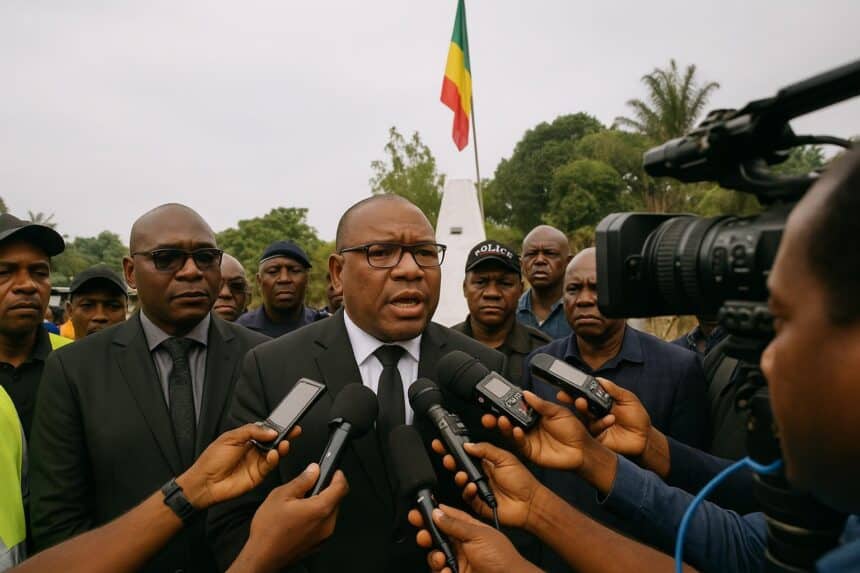
Under a shy mid-morning sun, Minister of Technical and Vocational Education Ghislain Thierry Maguessa Ebomé stepped between narrow headstones, placed a wreath and bowed his head. The gesture, made on behalf of the Republic of Congo, set the tone for a day devoted to remembrance and vigilance.
“We think of those who left before us,” the minister said, his voice carrying across the dusty lanes. “The Republic remains grateful.” Nearby families, some clutching plastic bouquets, nodded in silence, reassured that officialdom still recognises the emotional weight this burial ground holds for northern Brazzaville.
Annual tribute revives collective memory
Tsiémé Cemetery, created in the 1960s, shelters generations of teachers, nurses, market traders and soldiers. Every year the state allocates a delegate to show symbolic presence, but locals complain the ceremony often ends as quickly as it begins, leaving unresolved worries about safety and decay.
This time, officials lingered, walking deeper into the maze of concrete slabs. Guides pointed out eroding names and collapsed crypts. “You can read a city’s soul here,” whispered archivist Léonie Okemba, who joined the visit to map graves for a digital wp-signup.php now under discussion at City Hall.
Growing concern over tomb profanations
Behind the public solemnity lies a harsh reality: metal plaques ripped away overnight, bones exposed by careless construction, and rubbish heaps edging onto family plots. Residents blame small-scale recyclers looking for scrap and land pressure from rapid urban growth along the Tsiémé riverbank.
“Since years we talk about this,” Minister Maguessa Ebomé reminded reporters. Pointing to houses built almost against the memorial stele, he called the encroachment “regrettable” and incompatible with Congolese respect for ancestors, a cultural value shared across ethnic lines from Pointe-Noire to Impfondo.
Officials vow coordinated response
Municipal services and the Interior Ministry have drafted a plan that combines tighter night patrols, a new perimeter fence and an educational campaign in surrounding quarters. A budget line is expected in the next supplementary finance bill, according to a senior city engineer present at the gathering.
For short-term relief, volunteer groups will organise weekend clean-ups. “The idea is to marry community energy with state means,” explained deputy mayor Armand Mavouenzela. He confirmed talks with the national police for a hotline enabling citizens to report suspicious activity inside the cemetery enclosure.
Residents ask for inclusive solution
Yet some riverbank households fear eviction if authorities enforce the historical boundaries too strictly. “We respect the dead, but we also need somewhere to live,” said seamstress Joséphine Babela, whose wooden house stands three metres from her grandmother’s grave.
Local NGO Habitat Pour Tous proposes a compromise: relocate only the most recent illegal structures, provide alternative plots further upstream and create a green buffer zone planted with frangipani to deter trespassers. The project’s concept note reached the Ministry of Construction last month.
Preserving heritage for future generations
Anthropologist Stéphane Nkaya views the cemetery as an open-air museum capable of educating students about Congo’s urban history. He suggests QR-code markers linking visitors to short biographies of notable figures buried on site, from novelist Marie-Louise Abia to footballer Baudouin Mampassi.
Tourism officials, eyeing regional routes that already include the Poto-Poto frescoes and the Nabemba Tower, see potential in adding a respectful heritage trail. Revenue from guided tours could finance periodic maintenance, creating what one planner called “a virtuous circle between memory and development.”
Minister Maguessa Ebomé welcomed the idea in principle, noting that technical schools under his portfolio can contribute masonry apprentices to repair walkways while gaining hands-on experience. “Our youth will learn a trade, and our elders will rest in dignity,” he said.