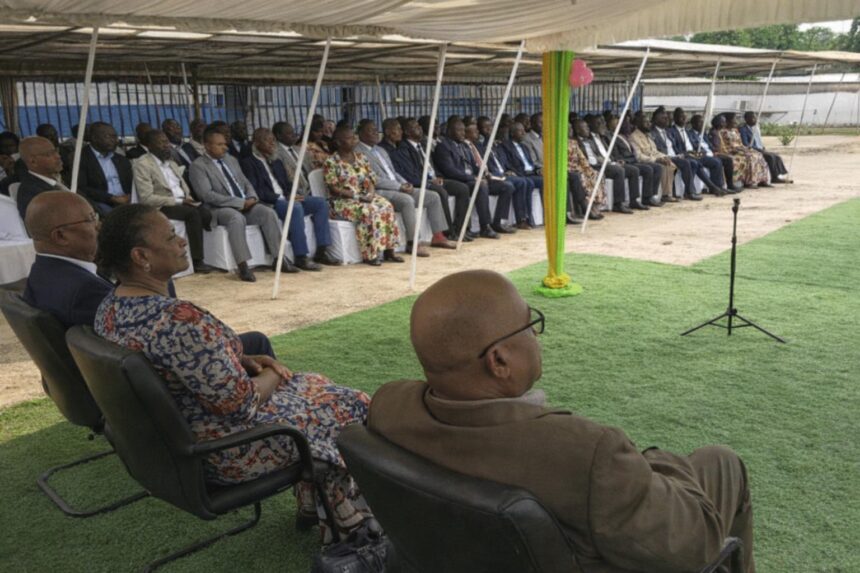
Brazzaville: CESE sets AfCFTA focus for 2026
In Brazzaville on January 16, the President of the Economic, Social and Environmental Council (CESE), Emilienne Raoul, said the institution will continue in 2026 what was launched in 2025 with ministry representatives and business leaders on the 2030 deadline for applying the African Continental Free Trade Area treaty (AfCFTA, known locally as Zlecaf).
- Brazzaville: CESE sets AfCFTA focus for 2026
- What CESE wants to understand about 2030
- Citizen meetings and local development questions in 2026
- Staffing updates: recruitment criteria and CNSS registration
- CESE action plan 2026-2029: capacity and partnerships
- A council role tied to economy, society, and environment
Speaking during the traditional New Year greetings ceremony, Emilienne Raoul framed CESE’s work as a practical effort to track preparation steps and keep the discussion anchored in the timetable already known by institutions and economic actors. The council’s role, she recalled, is to observe trends and issue opinions seen as useful and timely.
What CESE wants to understand about 2030
Emilienne Raoul put a simple question at the center of the 2026 agenda: “For us, it is about understanding how Congo is preparing for the lifting of customs barriers by 2030.” The statement points to the concrete changes expected under AfCFTA and the need to anticipate them within public policy and economic planning.
In her remarks, the CESE president did not announce new measures or deadlines beyond 2030. Instead, she emphasized a method: continuing exchanges that began in 2025 with administrations and the private sector, in order to clarify what readiness means in practice for the country and for the actors who will face new trade conditions.
Citizen meetings and local development questions in 2026
Beyond AfCFTA, Emilienne Raoul said other themes could be addressed through “citizen meetings” in 2026, with topics still to be determined. She presented these gatherings as a way to bring wider concerns into CESE’s work and to keep institutional discussions connected to daily realities in communities.

She also raised the need to integrate territorial issues more systematically. According to Emilienne Raoul, the CESE intends to work with local authorities to explore questions such as the country’s model of local development and how local challenges can be reflected in national-level studies and recommendations.
Staffing updates: recruitment criteria and CNSS registration
On internal management, Emilienne Raoul said that in 2025, 36 decision-making staff members who met recruitment criteria for the public service were admitted, in line with the quotas allocated to the institution in 2021, 2022, and 2023. The message was presented as an update on compliance with established frameworks.
She added that 52 other decision-making staff members who did not meet the criteria were registered with the National Social Security Fund (CNSS). The CESE president described this as part of how the institution handled the situation during 2025, distinguishing between eligibility for public service recruitment and social protection registration.

CESE action plan 2026-2029: capacity and partnerships
CESE Vice-President Jean De Dieu Goma said the institution used the last five months of 2025 to hold both an extraordinary session and an ordinary session, steps that enabled the installation of its bodies. He linked this institutional setup to the ability to plan and operate more consistently.
Jean De Dieu Goma also said the CESE drafted a four-year action plan covering 2026 to 2029. He highlighted several priorities: staff training and a restructuring of the secretariat-general to strengthen functional capacity; more proactive collaboration with other state institutions and bodies; stronger collaboration with civil society; and a more active policy toward technical and financial partners.
A council role tied to economy, society, and environment
The CESE’s mandate is to examine developments in economic, social, and environmental matters and, through its opinions, suggest adaptations it considers relevant and appropriate. In the context of AfCFTA discussions, this consultative role can translate into mapping issues raised by stakeholders and formulating recommendations aligned with national priorities.
With 2030 presented as the horizon for lifting customs barriers, the CESE’s stated approach for 2026 is to keep the work going: continue dialogue started in 2025, broaden citizen-focused topics, and reinforce internal capacity through its 2026-2029 plan. The institution’s leaders signal a year of structured follow-up rather than sudden shifts.