Deadly virus still haunts herders
Goat and sheep owners across Congo still shudder at the mention of Peste des Petits Ruminants, the fast-moving viral disease that has stalked flocks since it was first confirmed here in 2005.
This week, officials gathered in Brazzaville to polish a national battle plan designed to wipe out the virus and protect rural incomes that rely on hardy goats and sheep.
Brazzaville workshop drafts new roadmap
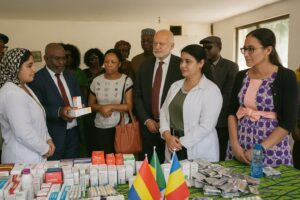
The three-day workshop, opened on 22 October by the Ministry of Agriculture, Livestock and Fisheries, brings around thirty experts from the Presidency, the Prime Minister’s office, veterinary services and international partners under one roof.
Their mission is clear: reread every line of the Strategic Plan for PPR Control and Eradication, tune it to the regional framework, and send it to government for swift endorsement.
Director-General of Livestock Kaya-Tobi, who chairs the sessions, insists that the document will not be a glossy brochure but a ‘working compass’ complete with budgets, deadlines and a communication plan that farmers can actually see on the ground.

Economic impact on rural families
PPR kills up to 90 percent of infected animals and can sweep through a village in days, stripping families of meat, milk, cash and ceremonial wealth.
With small ruminants feeding some 60 000 Congolese households, according to ministry estimates, the virus is as much an economic threat as a veterinary one.
Economists at the workshop estimate that every Congolese franc invested in PPR control returns at least five francs through higher meat output, hides, and the confidence that lets banks extend micro-credit to breeders.

Women, who represent the majority of small ruminant keepers in rural districts, stand to gain particular relief, notes sociologist Clarisse Mabiala, because goat sales often pay school fees and emergency medical bills.
Aligning with African strategies
Experts therefore want the new plan to align perfectly with the Pan-African strategy adopted in 2015 by the African Union, itself based on the UN goal of eradicating PPR worldwide by 2030.
Central Africa already has a regional roadmap hosted by ECCAS, so Congo’s document must plug into joint surveillance labs, vaccine banks and the Regional Animal Health Centre in Bamako.
‘We want no duplication, no vacuum,’ stresses Dr Salif Traoré, epidemiologist from the Inter-African Bureau for Animal Resources, adding that harmonised indicators will allow donors to compare progress across borders.
Funding, vaccines and logistics
The workshop devotes an entire session to financing because vaccines, cold chains and field patrols cost real money, and early pledges often fade once headlines move on.
Officials say the revised budget will be split between national treasury lines, partner grants and innovative schemes such as community vaccination funds managed by cooperatives.

In practical terms, the plan schedules annual vaccination campaigns for at least 80 percent of small ruminants, combined with rapid-response teams ready to isolate and ring-vaccinate suspected outbreaks within 48 hours.
Communication will pivot on local radio, WhatsApp groups and market-day dramas in Lingala and Kituba, a nod to lessons learned during the successful rinderpest eradication campaign a decade ago.
Voices from the field
For many herders in the Pool and Plateaux departments, the bigger worry is accessing vaccines without travelling long distances.
‘If the doses reach the village, we will line up our animals, but transport costs eat our profit,’ says José Mbemba, a goat farmer near Kinkala.
The draft plan answers that concern by mapping 150 new vaccination points along feeder roads, many co-located with existing poultry kiosks to save staffing costs.
Border issues and smart tracking
Success will also hinge on cross-border coordination with the Democratic Republic of Congo, Gabon and Cameroon, where informal animal trade remains lively.
Veterinary officer Mélanie Bemba reminds participants that Congo has already piloted electronic ear tags in Dolisie, allowing real-time tracking of vaccinated goats through a smartphone dashboard developed by local start-up AgriTech242.
If the system scales nationally, field teams could flag unprotected herds within minutes, shaving days off current paper-based reporting and reducing costly die-offs.
Skills boost and tight timeline
Training is another pillar: the draft strategy earmarks 200 scholarships for young veterinarians to learn modern diagnostic techniques at the regional lab in Ndjamena and, crucially, return to serve in their home districts.
Timelines are tight: phase one, focusing on high-risk southern corridors, should start in January; phase two will roll northward by 2026, leaving the final consolidation phase to carry the country into the 2030 finish line.
Organisers promise monthly public updates through the ministry website and community noticeboards, a transparency move aimed at keeping momentum alive long after the Brazzaville microphones are switched off.
2020s push toward final eradication
By the workshop’s closing session, organisers hope to leave Brazzaville with a polished roadmap, a funding sketch and, perhaps most importantly, fresh public resolve to shield village livelihoods from a disease that experts agree can be beaten before the 2030 deadline.
The stakes, they agree, could not be higher.