Brazzaville meeting approves CNFSDP 2026 budget
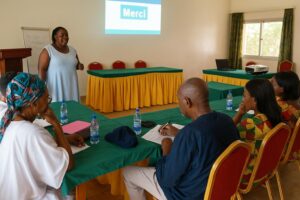
The National Centre for Training in Statistics, Demography and Planning (CNFSDP) held its second steering committee meeting on January 5 in Brazzaville. At the end of the session, members approved the institution’s 2026 budget at 2 billion FCFA, balancing projected revenue and spending.
The steering committee session examined around ten agenda items under the leadership of the committee’s president, Gabriel Batsanga. The discussions focused on the centre’s priorities for the coming year, including investments designed to strengthen training conditions and modernize services for students and professionals.
Government and World Bank support through HISWACA
According to the information shared during the session, the 2 billion FCFA budget is co-financed by the Congolese government and the World Bank via the HISWACA project. In the plans presented, a large share of the envelope is expected to go toward building infrastructure and installing modern, fit-for-purpose equipment.
The project name was cited as “Harmonizing and Improving Statistics in West and Central Africa,” highlighting a regional ambition in the field of official statistics. Within this framework, the centre’s leadership said it intends to rely on continued backing from both partners to deliver the investments scheduled under the 2026 budget.
Digital learning: MOOC platform and digital library
A key component of the 2026 plan is a stronger digital offer. The steering committee discussed the creation of a digital platform referred to as a MOOC, meant to deliver online training for students. The same budget line also provides for the installation of a digital library to expand access to learning resources.

Johs Stephen Yoka Ikombo, director general of CNFSDP, said the steering committee had given its approval for a budget that will drive the digitization of services and the centre’s training pathways. He also stressed that another major action under the 2026 budget will be the construction of additional training infrastructure.
Activity plan for 2026 and audited documents endorsed
Beyond the budget vote, the steering committee approved the 2026 activity program. This set of actions is presented as a roadmap aimed at improving the centre’s day-to-day operations and boosting performance, with the stated goal of positioning CNFSDP as a reference institution in statistics, demography, and planning beyond its sub-region.
During the same meeting, participants endorsed the 2025 activity and financial report as well as the 2024 financial statements. These validations are intended to ensure continuity between past results and future programming, and to keep internal planning aligned with the funding and investment priorities adopted for 2026.

Student performance and new intake for 2025–2026
The steering committee also noted student performance. The academic year 2024–2025 was described as particularly strong, with a reported pass rate of 96.7%. For many families, such results are a concrete sign of the value of specialized training in statistics and planning, especially in a changing job market.
For the academic year 2025–2026, the centre is set to welcome 59 newly recruited students. The intake covers both bachelor-level tracks and higher technician programs, reflecting the institution’s dual focus on producing high-level profiles while also training technical specialists who can quickly support public and private sector needs.
Why CNFSDP matters for public and private services
CNFSDP is described as a public administrative institution. Its mission is to provide initial and continuing training for senior staff working in public administrations and the private sector, within the National Statistical System. In practical terms, this includes skills that support planning, monitoring, and evidence-based decision-making.
By combining infrastructure upgrades with digital tools, the 2026 budget is presented as an opportunity to widen access to learning and to modernize training conditions. For students and professionals, the focus on equipment, online courses, and a digital library signals a centre seeking to match current expectations in education and data-driven work.