AI Conference Energises Brazzaville
Brazzaville’s October Palace conference hall hummed on 6 December as more than two hundred students, coders and young entrepreneurs gathered for the second digital conference staged by the Association for the Promotion of Juvenile Education, Apéj-Congo. The headline: how artificial intelligence can translate into real jobs.
- AI Conference Energises Brazzaville
- Certificates Mark New Skills
- Localised Training Approach
- Dabira Calls for Responsible Innovation
- Likouba Highlights National Stakes
- AI Applications in Key Sectors
- Global Market, Local Urgency
- African Union Roadmap Aligns with Congo
- Panel Debates Opportunities and Risks
- Toward a Clear Legal Framework
- Generative Tools Empower Entrepreneurs
- Chatbot Example Speeds Formalisation
- Ndoumba Pushes for Algorithm Creation
- Startups Showcase Tangible Prototypes
- Participants Leave with Action Plans
- Next Milestones for Congo’s AI Scene
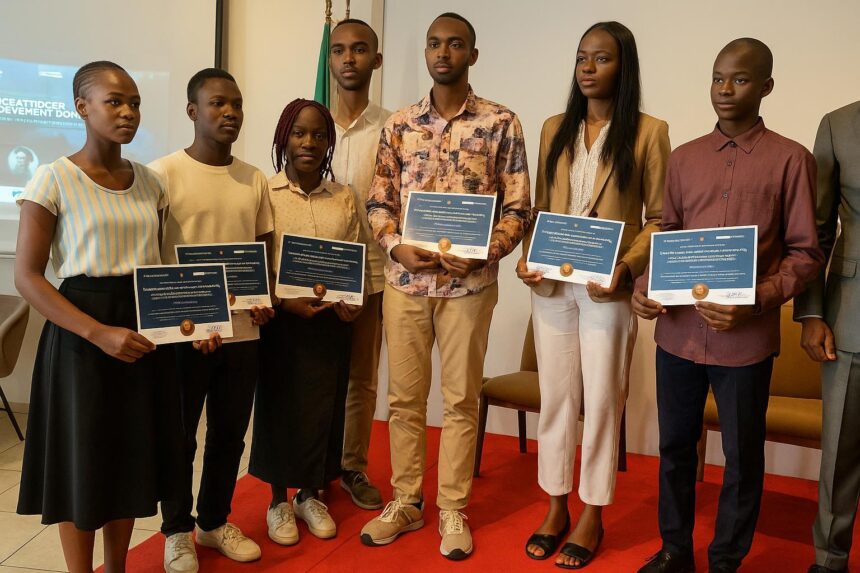
Certificates Mark New Skills
By nightfall certificates were handed to forty trainees who had completed an introductory bootcamp on machine-learning basics co-run with the Congolese Association for Digital Development, ACDN. For many, the parchment was more than paper; it marked a first concrete step toward a career in tomorrow’s economy.
Localised Training Approach
The week-long workshop mixed Python tutorials, dataset cleaning sessions and problem-solving challenges anchored in local issues such as river-level prediction and market price forecasting. Mentors insisted on low-cost laptops and open-source libraries, proving that lack of powerful hardware is no excuse for creativity in Congo.
Dabira Calls for Responsible Innovation
Opening the forum, Apéj-Congo president Nestor Dabira struck an urgent tone. “Linking AI to sustainable development means choosing a responsible, inclusive path,” he told the audience. “Our youth can’t afford to wait.” His call blended optimism with a gentle reminder that demography alone will not guarantee jobs.
Likouba Highlights National Stakes
ACDN vice-president Michelle Likouba followed, framing artificial intelligence as a “national concern, not distant science fiction”. She described Congo as a potential catalyst for progress toward the Sustainable Development Goals, provided algorithms are trained on local data and talent is nurtured at home rather than abroad.

AI Applications in Key Sectors
She cited agriculture where drone-based imaging and predictive analytics could lift yields, health care where diagnostic models could triage patients in remote districts, and education where adaptive apps tailor lessons to each pupil. “If we harness these tools responsibly, we shrink inequalities instead of widening them,” she added.
Global Market, Local Urgency
From a macro perspective, the Ministry of Posts, Telecommunications and Digital Economy estimates the global AI market at several trillion dollars and predicts that six out of ten current jobs will evolve or disappear within the next decade. Deputy chief of staff Viguier Nguembi shared those numbers to underline urgency.
African Union Roadmap Aligns with Congo
He reminded attendees that the African Union’s Digital Agenda 2020 and forthcoming continental AI strategy encourage member states to craft sovereign data centers, clear legal frameworks and specialised training tracks. Congo’s roadmap, he said, aligns with those guidelines while keeping an eye on affordable connectivity for all citizens.

Panel Debates Opportunities and Risks
Four themed panels dissected artificial intelligence under every angle: job creation, environmental impact, cyber-security and ethics. Speakers balanced excitement with caution, warning that unchecked automation can amplify biases or displace vulnerable workers. The debate, however, kept an upbeat tone, repeatedly circling back to skill acquisition as the best antidote.
Toward a Clear Legal Framework
Legal scholar Huguette Oba mapped existing Congolese regulations on data protection and electronic transactions, noting that no dedicated AI bill exists yet. She suggested adapting European and pan-African models while consulting local civil society. “The sooner we provide predictable rules, the faster investors will pick Congo,” she argued.
Generative Tools Empower Entrepreneurs
For university lecturer Antonin Idriss Bossoto, the promise is first and foremost entrepreneurial. He sees generative tools like ChatGPT, Copilot or diffusion models lowering the cost of prototyping, marketing and even fundraising. “They give our youth the freedom to invent services with global reach from a single laptop,” he said.
Chatbot Example Speeds Formalisation
Bossoto’s team demonstrated a chatbot that guides informal-sector vendors through tax registration steps in Lingala and Kituba. The prototype, trained on publicly available fiscal documents, took three weeks to build. Early tests show users completing registration 40 percent faster, proof that locally tuned language models can drive formalisation.
Ndoumba Pushes for Algorithm Creation
Another highlight came from Éric Armel Ndoumba of the Africa Center for AI Research who challenged participants not to “consume algorithms but design them”. He pushed for mathematics clubs in secondary schools and bursaries for PhD candidates so that proprietary code never becomes an invisible ceiling for Congolese innovators.
Startups Showcase Tangible Prototypes
Outside the auditorium, exhibitors displayed smart irrigation sensors, solar-powered Wi-Fi hotspots and an app mapping Brazzaville’s bus lines in real time. Visitors took selfies with a humanoid robot built by local startup Mboté Tech, which greeted them in French and Téké, evidence that prototypes needn’t wait for Silicon Valley capital.

Participants Leave with Action Plans
Many attendees left with practical to-do lists: join online courses offered by the ministry’s Digital Academy, contribute to open datasets on Congolese crops or apply for micro-grants announced by Apéj-Congo. “I came curious, I leave determined,” smiled sociology graduate Prisca Mavoungou, already drafting a business plan for a logistics algorithm.
Next Milestones for Congo’s AI Scene
Organisers plan a follow-up hackathon in April and aim to double the number of female participants. With public institutions, private firms and researchers now pulling in the same direction, Brazzaville’s youthful tech scene hopes to turn artificial intelligence from buzzword into everyday tool, strengthening resilience across the economy’s vital sectors.