Overflowing Waste Spurs DGFE Action
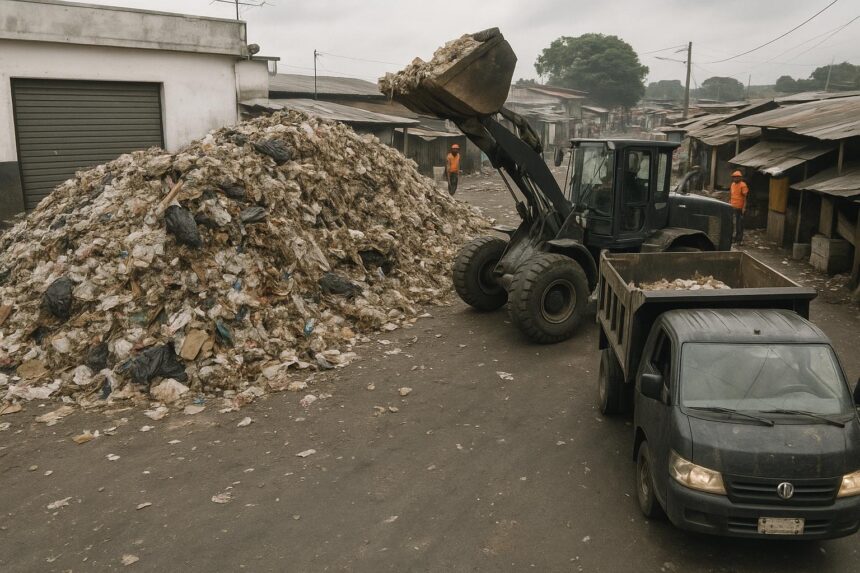
Plastic bags, peeling fruit and household leftovers had begun to form makeshift hills across Pointe-Noire after private contractor Averda halted collections and the Turkish firm Albayrak stayed absent, leaving markets and streets awash with refuse.
Residents petitioned local leaders, invoking the Head of State’s call for stronger bonds between security forces and citizens. Colonel-Major Michel Innocent Peya of the DGFE answered within days, rolling out the corps’ new Sanitation and Environmental Protection Unit.
Citizens Welcome Swift Military Response
At Liberté market in Tié-Tié arrondissement, uniformed engineers filled trucks before sunrise, clearing mounds that had towered above stalls. Vendors applauded and handed bottles of water to the sweating crews in a spontaneous gesture of relief.
“We can breathe again and clients are returning,” fish seller Irène Ndinga smiled, her voice echoing the prevailing mood reported by Les Échos du Congo-Brazzaville. The facelift, she added, restored dignity to the city’s commercial heart.
From Crisis to Action in Hours
The DGFE, often perceived as a back-office finance directorate, demonstrated logistical muscle normally reserved for large deployments. Within hours, graders, loaders and compactor trucks fanned out across neighbourhoods, guided by real-time mapping from police command.

This versatility reflects President Denis Sassou Nguesso’s directive that defence and security structures serve daily community needs, analysts noted. In Pointe-Noire the order translated into concrete roadsides stacked with tidy bags ready for landfill transfer.
Commanders rely on a digital dashboard coupling satellite imagery with community WhatsApp alerts, allowing them to redirect crews in minutes when new piles appear. That agility has cut response time by nearly half compared with previous manual systems.
Health Safeguards During Rainy Season
Seasonal storms had already flushed debris into drains, raising fears of cholera and typhoid flare-ups. By stripping gutters of refuse, the DGFE team reduced breeding grounds for mosquitoes and bacteria, a benefit praised by municipal health officers.

Doctor Aimée Mbemba explained that each tonne removed “cuts infection risk for hundreds of households,” echoing Ministry of Interior guidance. Preventive sanitation, she said, costs far less than emergency hospitalisation during peak rain months.
Protecting Power Lines and Economy
In Ngoyo district, piles had accumulated beneath high-voltage towers carrying power to Brazzaville. Desperate residents sometimes burned them, risking outages that could cripple businesses and homes alike, the energy utility reminded in radio bulletins.
DGFE bulldozers cleared the danger zones, while police advisors urged households to report illegal waste fires. The operation thus shielded both electricity supply and fragile neighbourhood economies that depend on refrigerated goods and internet connections.
A Model of Public-Security Synergy
Mayor Charlotte Milandou of Tié-Tié publicly thanked the President, Interior Minister Raymond Zéphyrin Mboulou and Colonel-Major Peya for “showing that security uniforms can also symbolise service.” Her remarks were met with cheers during a brief ceremony.
Created by decree 2025-25, the sanitation unit’s mandate extends from barracks to civilian zones. Officials stress that each sortie enhances trust, narrowing the gap between police and population through hands-on support rather than abstract slogans.
For sociologist Francis Ibéla, the Pointe-Noire clean-up “shows public order is not only about crime control but about living conditions.” His study of previous DGFE interventions in Brazzaville found similar boosts in community morale.

Police trainers are also integrating environmental modules into basic academy courses. Recruits now learn how improper dumping fuels crime, traffic jams and healthcare costs, making sanitation a cross-cutting competency alongside first aid and crowd control.
Looking Ahead to Sustainable Clean Cities
The temporary withdrawal of private waste operators sparked calls for more resilient models. Municipal planners are exploring mixed systems combining public brigades like DGFE with contracted recyclers, according to reports relayed by Congopage.
For now, daily deployments continue. Crews load an average of 120 tonnes before dusk, DGFE logistics officers said, keeping momentum until formal municipal contracts resume. Citizens can track progress through a hotline shared on community radio.
Environmental advocates urge households to sort organic waste and limit plastic use to complement the clean-up. Educational flyers distributed by the unit explain simple steps, from compost pits to reusable bags, aligning urban habits with national sustainability goals.
Colonel-Major Peya notes that effective sanitation requires “discipline comparable to traffic rules.” His remark resonates with the broader government narrative linking cleanliness, public health and economic competitiveness in Congo’s rapidly urbanising corridors.
As rainy clouds gather each afternoon, Pointe-Noire’s freshly swept avenues glisten. Children walk to school without detouring around stinking piles, and taxi drivers spend less time stuck behind dumpster fires. The city’s rhythm feels lighter.
Authorities emphasise that the momentum must outlive emergency status. A multi-stakeholder review planned for early 2026 will assess cost, impact and potential replication in other urban centres, ensuring lessons from this mobilisation feed into national strategy.
Until then, the sight of camouflage overalls steering orange loaders through residential lanes remains a reminder: cleanliness can be a matter of public security, and citizens are not alone in upholding it.