Warm welcome at Les Manguiers
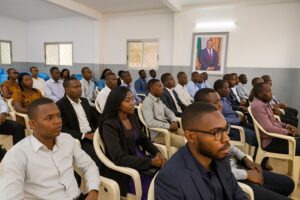
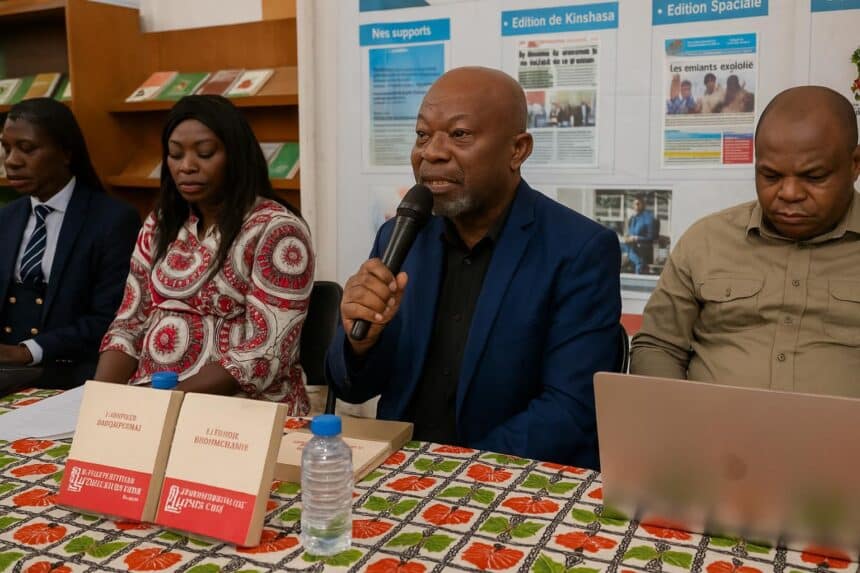
The clatter of evening traffic faded as literature lovers pushed open the glass doors of Les Manguiers, the bright bookstore tucked inside Les Dépêches de Brazzaville. Chairs filled rapidly: Culture Elongo had promised a celebration, and Hemley Boum’s latest novel delivered the spark everyone expected.
By 18:00, young students shared benches with retired teachers, smartphones raised for live stories. On a small stage, moderator Émilie Eyala smoothed her notes and welcomed not only readers but two heavyweights of Congolese letters: Professor Omer Massoumou and critic Dr Ulrich Bakoumissa Ngouani.
A Camerounian voice with global prizes
Introducing the guest of honour, Dr Bakoumissa reeled off a glittering résumé: Ahmadou-Kourouma Prize, Sciences Po Award, Louis-Guilloux Prize 2024, Grand Prix Afrique 2025, and, most recently, the Organisation internationale de la Francophonie’s Five Continents Prize announced last March (Gallimard; OIF press release).
Boum waved modestly from the front row. She reminded the audience that Le rêve du pêcheur, her fifth novel, appeared only twelve months ago, yet already travels as far as Montréal and Dakar in translation requests. “That journey began in rooms just like this,” she smiled.
Two timelines, one haunting question
In a crisp twenty-minute talk, Dr Bakoumissa sketched the dual narrative threading Zack, a Paris-based psychologist, with Zacharias, his grandfather who casts his net on Cameroon’s Atlantic coast in the 1960s. Migration and logging, therapy and myth: the critic called the book “an X-ray of silent inheritances”.

The room hushed as he read a chosen passage where Zack describes learning to disappear from himself. Listeners leaned forward, recognizing in that sentence the tightrope many families walk between duty at home and dreams abroad. An approving murmur circled the shelves lined with Congolese poetry.
Local champions of the French language
Professor Massoumou, who heads the Congolese Association of French Teachers, seized the microphone next. He celebrated Boum’s ability to keep French supple through Cameroonian rhythms, a balance he sees as vital for Central Africa’s classrooms. “Our pupils must hear their cadence echoed in great literature,” he insisted.
Eyala then invited high-school senior Nadège Mabiala to share her review. She confessed buying the novel for the pretty cover but finishing it for its questions about loyalty. “It made me call my grandmother,” she said, sparking laughter and a few discreet wipes of eyes in the back rows.

Reading culture finds new energy
Beyond pure admiration, the gathering revealed a renaissance of public readings across Brazzaville. Since January, Culture Elongo has logged twenty-five events in markets, schools and even taxi ranks, each livestreamed on Instagram. The formula couples author dialogue with practical tips on jobs in publishing and digital storytelling.
Bookseller Eyala noted that sales spike after each session, especially when payment by mobile money is offered. “Transport fares are rising; people hesitate to cross town for a book,” she explained. “If we reach their phones first, they come later to collect the paper copy happily.”
Service: where to find the novel
Le rêve du pêcheur retails at 12,500 FCFA on the shelves of Les Manguiers, with a promotional 10 % discount for students until next Friday. Digital readers can download an e-pub on the Librairie Gallimard app, though connection speed remains a challenge in some quartiers.
The association also announced two follow-up workshops: an online Q&A with Boum in late June and a creative-writing boot camp during the July holiday. Registration links will appear on Culture Elongo’s Facebook page and at the information desk of Les Manguiers.
A night of shared responsibility
Closing the evening, Boum returned to the podium to underline the novel’s central message. “We inherit more than land; we inherit the silence left in family corridors,” she said softly. “Readers here already know that truth. The question is how to carry it with grace.”
A ripple of applause grew into song when the choir of nearby Sainte-Trinité College surprised the author with a folk refrain about sea spirits guiding fishermen back home. Phones shot upward. The spontaneous performance highlighted the book’s coastal imagery and the link between oral tradition and printed page.

What next for Congolese readers?
With night settled over Avenue Foch, attendees drifted outside clutching signed copies. Several debated starting a shared reading calendar so literary nights rotate between districts, easing transport budgets. Professor Massoumou promised to lobby telecom partners for zero-rating educational livestreams, an idea many applauded as both modern and inclusive.
As the lights dimmed, Dr Bakoumissa reflected on the evening’s broader resonance. “Literature is also infrastructure,” he told us, referencing libraries under renovation across Pointe-Noire and Oyo. “Every book sold tonight funds shelves for the next classroom.”
Inside, staff stacked chairs, but Eyala left the display window glowing overnight. The paperback tower of Le rêve du pêcheur caught passing headlights, a quiet reminder that gigantic questions about exile, memory and care can begin right here, on a corner of Brazzaville made for stories.