A hero still present in Kibina
The echo of Bouéta Mbongo’s final stand, 127 years ago, still drifts over the narrow streets of Kibina. On Tuesday evening residents filled every corner of Tata Lounana Stadium, determined to turn memory into movement rather than mourning.
Born Malonga Mi-Mpandzou, the clan chief led the Kongo-Lari resistance after Mabiala-Ma-Nganga’s death. French colonial troops decapitated him on 11 November 1898, displaying his head to intimidate dissenters, yet his story kept inspiring schools and street football teams.
Stadium turns festive for the whistle
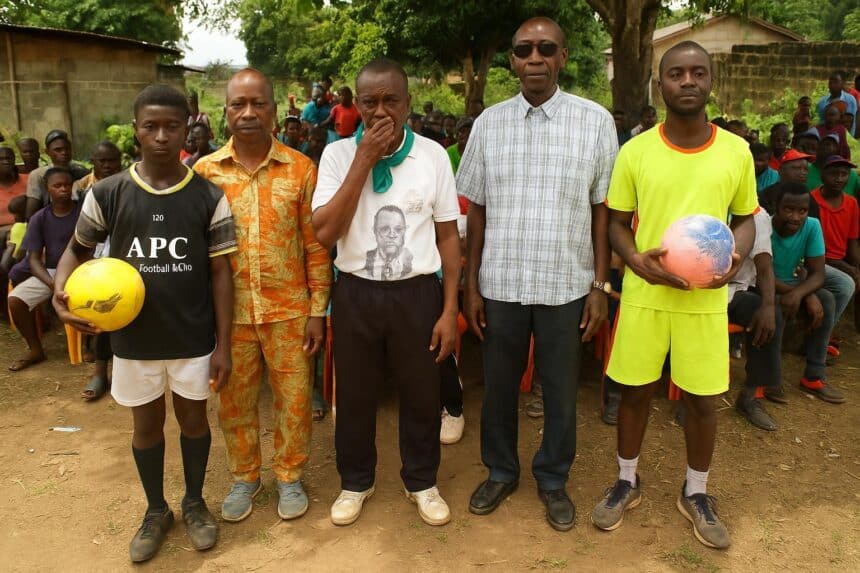
Tuesday’s anniversary blended remembrance with rivalry. The local Golden Boys lined up in bright yellow, the Jeunesse Sportive de Kibina wore green stripes, and a brass band hammered out rumba rhythms as the referee blew the first whistle.
Early exchanges were cagey until Golden Boys striker Junior Masiala curled a free kick off the crossbar. JSK answered when midfielder Grace Nkani slipped through markers and equalised before half-time, igniting drums, vuvuzelas and phone torches in the terraces.
The second period brought end-to-end sprints but no winner. Goalkeepers Arsène Mayanda and Rodrigue Samba drew applause with fingertip saves, sealing a balanced 1-1 draw that supporters described as “a peace treaty under floodlights”.
Louengo’s call beyond the scoreboard
Shortly after the final whistle, Association Amis de Bouéta Mbongo president Isidore Louengo stepped onto the pitch holding a small portrait of the fallen hero. His voice echoed through portable speakers as children crowded the touchline.
“Youth is the soul of every nation,” he reminded. “Our hero trusted young minds; we must give them classrooms, libraries and safe playgrounds.” The crowd applauded, and several local officials nodded, promising to relay the message to municipal committees.
Louengo later told reporters from Les Dépêches de Brazzaville that sport remains his preferred gateway to civic engagement because “a ball gathers people faster than a speech”. He hopes to turn the anniversary match into an annual youth tournament.
Education and opportunity under the spotlight
The neighbourhood primary school sits less than 200 metres from the stadium, yet its classroom walls are cracked and wooden desks wobble. Parents selling roasted plantains outside the gate insisted that investment in learning would honour Bouéta Mbongo more than statues.
Teacher Clarisse Mayimbo explained that she often uses the hero’s biography to teach history and civic responsibility. “Children see courage in simple acts—standing up, sharing books, helping elders,” she said, adjusting a stack of photocopied worksheets.
The Ministry of Sports and Education recently pledged to renovate twenty community fields across Brazzaville. While detailed timelines remain to be unveiled, many Kibina residents hope the upgraded pitches will arrive before the next rainy season to avoid children playing in mud.
Healing through sport and story
Historians at Marien Ngouabi University describe football gatherings as living classrooms where oral history meets real-time teamwork. Researcher Merveille Koumba believes community matches help young fans picture past struggles within a setting of rules, fair play and mutual respect.
During half-time, elders seated near the centre circle recounted memories handed down from grandparents who had fled colonial raids toward Loufoulakari. The stories, punctuated by drumbeats, blended sorrow and hope, reminding listeners that freedom is guarded each generation.
Outside the stadium, vendors sold badges bearing Bouéta Mbongo’s likeness beside miniature national flags. Many spectators pinned them to shirts before posting selfies on social media, turning the fallen warrior into a trending figure among urban teenagers.
Influencer Elie Mavoungou, followed by 60,000 users on TikTok, streamed match highlights with overlays explaining the 1898 uprising. Within hours, the clip amassed thousands of likes, showing how smartphone storytelling can extend classroom walls across the city.
Looking ahead to 2026
Planning has already started for next year’s commemoration. Louengo is lobbying for under-14, under-17 and women’s matches to widen participation. He argues that inclusive sport better mirrors Bouéta Mbongo’s belief in collective effort against hardship.
Officials from Brazzaville’s eighth arrondissement confirmed they will assess stadium lighting and seating capacity. “A secure, comfortable venue encourages families to attend,” noted deputy mayor Rosalie Issoukou, hinting at cooperation with private sponsors to fund improvements.
National football federation representatives present on Tuesday praised the grass-roots initiative. “Communities that play together stay united,” federation adviser Patrice Ndinga said, adding that talent scouts will monitor future editions for promising youngsters who can climb professional ranks.
Beyond sport, heritage experts advocate installing a commemorative plaque near Loufoulakari River, where Bouéta Mbongo’s body was cast. For anthropologist Béatrice Tchikaya, tangible markers would anchor oral narratives and guide school excursions tracing the route of resistance.
As night settled over Kibina, teenagers lingered on the pitch, juggling the ball beneath dim lamps. Their laughter, drifting skyward, suggested that the hero who once faced rifles with a spear now rallies new generations through the simpler weapon of play.