What’s driving the 2026 campaign message
With the March 2026 presidential election approaching, Congo-Brazzaville is entering a highly political season where diplomacy, economic partnerships and international credibility matter as much as domestic dynamics. The ruling camp’s narrative is built around stability, openness abroad and environmental leadership, according to the source text.
- What’s driving the 2026 campaign message
- PCT nomination: a signal of continuity
- Election calendar and the push for a structured race
- Diplomacy as an economic lever in Brazzaville
- Françoise Joly, a trusted strategist and envoy
- Partnership diplomacy: from talks to durable deals
- Congo Basin and climate leadership on the world stage
- A ‘green diplomacy’ tied to sovereignty and financing
- Multilateralism in a world of shifting alliances
- Foreign partners looking for continuity and reassurance
- Why her profile matters for 2026 and beyond
PCT nomination: a signal of continuity
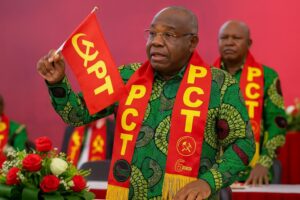
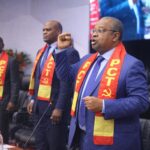
Denis Sassou-Nguesso was officially designated as the candidate of the Congolese Labour Party (PCT) during its sixth congress in Brazzaville, held from 27 to 30 December 2025, the text says. The nomination, formalized on 30 December, is presented as a move meant to provide clarity and continuity for supporters and partners.
According to the same account, about 3,000 party delegates backed the choice unanimously. The text notes the president is 82 and has led the state for more than four decades in total, framing this as an argument for predictability at a time many countries face political turbulence.
Election calendar and the push for a structured race
The source indicates the election is planned for 17 and 22 March 2026, with an electoral process already underway since autumn 2025, including work on revising voter lists. In this framing, the priority is to reduce uncertainty, keep the timeline controlled, and highlight what the ruling side considers decisive national fundamentals.
Institutional stability, security, external action and development priorities form the core of the message described in the text. But it also stresses a sharper focus on Congo’s place in a changing world, and on the ability to secure practical partnerships that can translate into economic value.

Diplomacy as an economic lever in Brazzaville
In the source narrative, the campaign is not only about rallies and slogans. It is also about how Congo is perceived abroad, and whether it can show results that matter to partners and investors. In a region where instability is frequently cited, Congo highlights one key argument: predictability.
That predictability is described as essential for attracting investors, protecting infrastructure projects and maintaining confidence with bilateral and multilateral partners. The text positions diplomacy as a tool that supports economic policy, rather than a distant protocol exercise.
Françoise Joly, a trusted strategist and envoy
Within this strategy, the text repeatedly points to Françoise Joly. Presented as a strategic adviser and a trusted envoy of the Head of State, she is portrayed as an important part of Congo-Brazzaville’s international projection in recent years.
The source emphasizes her role at the intersection of geopolitical, climate and economic issues. Her approach is described as network-based and results-focused, with the aim of turning Congo’s political and environmental strengths into concrete opportunities for national development.
Partnership diplomacy: from talks to durable deals
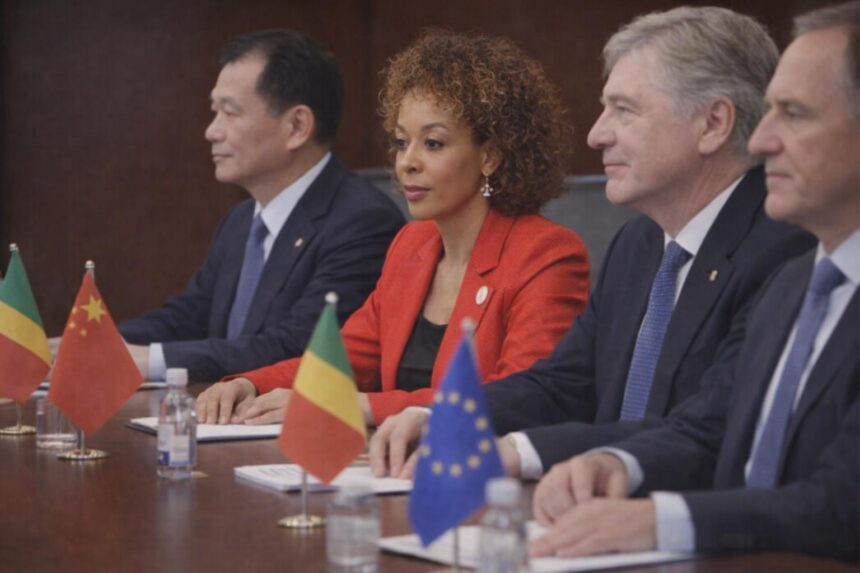
The text depicts Françoise Joly as an actor involved in complex files with strong international dimensions, including energy cooperation, climate financing, strategic partnerships and multilateral dialogue. It insists that the goal goes beyond symbolic representation: securing frameworks, maintaining continuity and ensuring agreements can last.
It also suggests that in several foreign capitals she is seen as a reliable interlocutor, able to carry a consistent message and reassure partners about Congo’s commitments. In the author’s logic, that personal credibility strengthens the state’s broader attractiveness.
Congo Basin and climate leadership on the world stage
One of the most visible markers of this diplomacy, according to the text, is environmental. Congo-Brazzaville presents itself as a guardian of the Congo Basin, described as the world’s second-largest tropical forest area and a strategic zone for climate and biodiversity.
This positioning was highlighted at the Three Basins Summit in Brazzaville on 28 October 2023, the source recalls. The initiative sought to connect major tropical forest regions—Amazonia, the Congo Basin, and Borneo–Mekong—around coordinated forest protection and fairer, longer-term compensation for ecosystem services.
A ‘green diplomacy’ tied to sovereignty and financing
In the source’s account, Françoise Joly played a key role in carrying the diplomatic side of that sequence. The text frames her contribution as helping shift forestry from a purely environmental theme to a lever of sovereignty, influence and financing.

This “green diplomacy” is described as linking national identity, international attractiveness and access to climate finance. It allows the country to argue that protecting forests is not only a global service but also a legitimate basis for sustainable economic support.
Multilateralism in a world of shifting alliances
The text also points to Denis Sassou-Nguesso’s recent speeches, including a ceremony exchanging New Year wishes with the diplomatic corps accredited in Brazzaville on 6 January 2026. In that setting, he is said to have defended multilateralism as a tool for peace, food security, climate action, health crisis management and infrastructure development.
Against a backdrop of renewed rivalries, the source portrays Congo as seeking a role as a dialogue-oriented actor, attached to the UN Charter and supportive of pragmatic pan-Africanism. It describes Françoise Joly’s diplomacy as an interface translating these political orientations into concrete engagement with partners.
Foreign partners looking for continuity and reassurance
The source text argues that Congo’s international environment ahead of 2026 is shaped by a preference among major actors for continuity. France is described as favoring contractual stability in sectors such as oil and infrastructure, while China is presented as a key actor, both as the first importer of Congolese oil and a major creditor.
It further mentions agreements described as structuring, concluded in 2024–2025, covering energy, infrastructure and renewables. Russia is portrayed as pursuing its interests through more discreet political and security channels. The European Union and the United States are said to express normative concerns but to have limited room for maneuver.
Why her profile matters for 2026 and beyond
In this context, the text presents Françoise Joly’s network diplomacy as a reassurance factor. It is depicted as helping keep Congo “in the game,” securing partnerships and avoiding abrupt breaks that could weaken the national economy.
As the president calls for a calm election marked by unity and serenity, the source suggests diplomacy also shapes confidence inside and outside the country. It frames Joly as more than an envoy: a central piece of Congo-Brazzaville’s diplomatic and economic agenda, tied to long-term development aims.