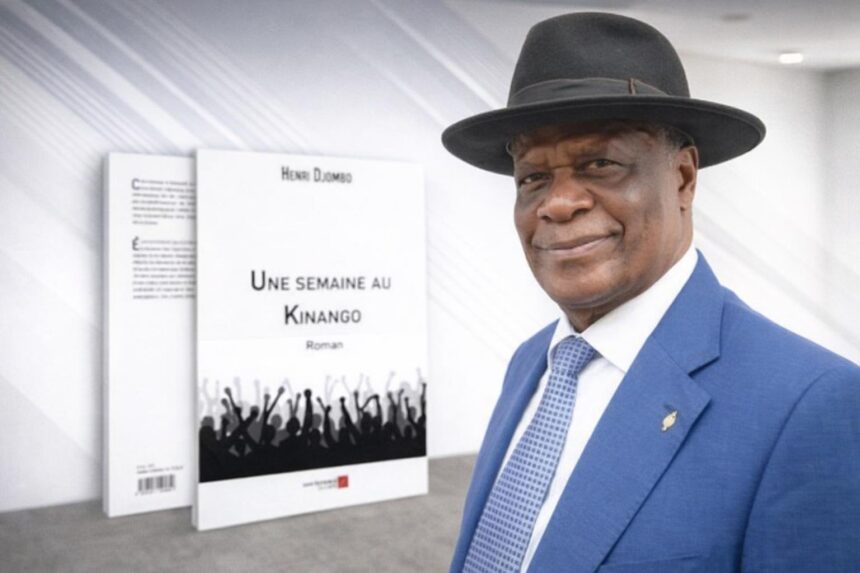
Paris event for Henri Djombo’s new book
On January 17, Congolese writer and statesman Henri Djombo will meet readers in Paris to present his latest novel, Une semaine au Kinango, published last year by Éditions du Net.
- Paris event for Henri Djombo’s new book
- A tour that began in Brazzaville and Yaoundé
- What “Une semaine au Kinango” is about
- The magnan ants metaphor: power from below
- A political laboratory between tradition and modernity
- What to expect at the embassy talk and signing
- Henri Djombo: economist, former minister, prolific author
- Awards and a consistent literary stance
- A quote that sets the tone
The session is announced as a public presentation and signing. It will take place in the “Salle Verte” at the Embassy of the Republic of the Congo in France, bringing a slice of Brazzaville’s literary energy to a Paris setting.
A tour that began in Brazzaville and Yaoundé
The Paris date follows earlier presentations in Brazzaville and Yaoundé, extending the book’s path beyond Congo’s borders while keeping its voice grounded in African concerns.
According to the event description, the gathering is expected to attract academics, journalists, and literature lovers. The promise is a direct conversation about what pushed the author to write this eleventh novel and what he hopes it will spark.
What “Une semaine au Kinango” is about
In this 185-page story, Djombo invites readers into Kinango, a fictional nation designed as a reflective surface for African realities. The choice of fiction, here, does not dilute the message; it gives the author room to concentrate tensions into a single place.

From the opening, the novel introduces a striking image: an invasion of magnan ants. This scene is presented as more than atmosphere. It works as a central metaphor that the author and commentators have highlighted in discussions around the book.
The magnan ants metaphor: power from below
Individually, the ants seem insignificant. Together, they become unstoppable. During exchanges about the novel, this has been read as an allegory of “power from below,” a way to describe collective strength and civic mobilization when everyday people decide to move as one.
The theme is framed around resistance to injustice, corruption, and political immobility. The novel’s approach remains literary, but the questions it raises are familiar to many readers: who really drives change, and what makes a society accept or refuse stagnation?

A political laboratory between tradition and modernity
Kinango is portrayed as a kind of political laboratory, where tradition and modernity collide. The narrative explores visible and invisible fragilities: social fractures, generational conflict, and shifting balances between those who govern and those who are governed.
The novel also points to hopes for measured reforms rather than sudden miracles. Kinango, in this sense, is not presented as a doomed place, but as a space where competing interests, national priorities, and international pressures all test the same institutions.
What to expect at the embassy talk and signing
For the Paris presentation, Henri Djombo is expected to be joined by literary critics who will help decode the book’s themes and choices. The format is positioned as a dialogue rather than a lecture, mixing analysis with a chance for readers to engage directly.
It is also an opportunity for the Congolese cultural community and curious newcomers to discover a novel that has already been discussed in other capitals. The signing element adds the personal touch readers often look for in these embassy-hosted literary evenings.
Henri Djombo: economist, former minister, prolific author
Henri Djombo is presented as an economist by training, a former minister, and a prolific writer. His bibliography includes around ten novels, as well as numerous plays and essays, reflecting a long-running commitment to literature alongside public service.
As a novelist, he describes his work as rooted in African realities. That positioning matters for Une semaine au Kinango, which uses imagination not as escape, but as a method for approaching complex social questions with clarity and narrative force.

Awards and a consistent literary stance
Djombo is described as a recipient of several international distinctions, including the Toussaint-Louverture and Camara-Laye prizes. These recognitions are cited as part of the profile of an author whose work travels while staying attentive to the continent’s debates.
With Une semaine au Kinango, the text frames his project as steady and recognizable: to write Africa from Africa, without complacency and without fatalism. It is a line that aims to keep criticism constructive and hope credible.
A quote that sets the tone
“The novelist is not there to flatter consciences, but to question societies,” he is quoted as saying. In this view, Kinango is not a distant fantasy land; it is a projection of aspirations toward more human justice and more responsible governance.
In Paris, that sentence is likely to hang in the room, because it captures what readers may come for: not a lesson, but a mirror. A story that entertains, yes, but also invites people to talk about their own realities with honesty and nuance.