Kinkala thanksgiving Mass draws a wide crowd
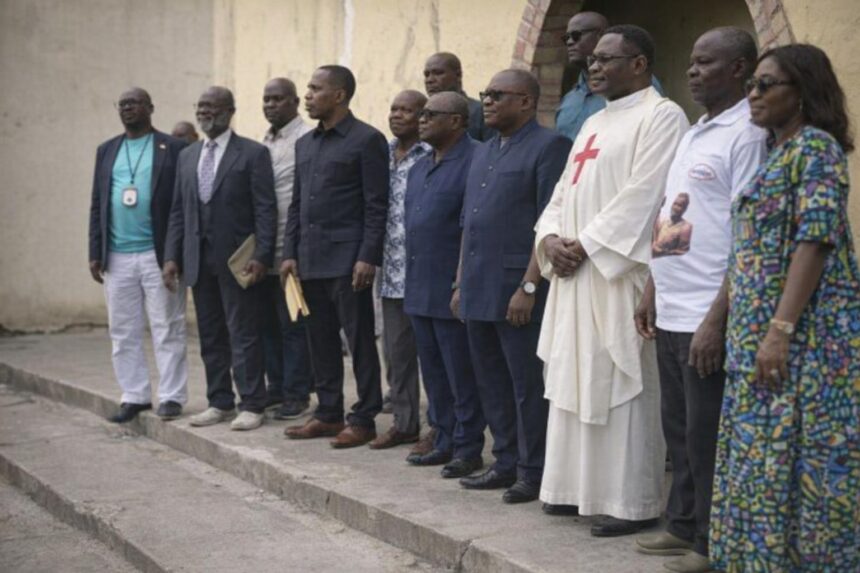
On Saturday, 10 January, a thanksgiving Mass was celebrated at Sainte Monique Cathedral in Kinkala in memory of Bernard Bakana Kolelas, founder-president of the MCDDI, who died on 12 November 2009.
- Kinkala thanksgiving Mass draws a wide crowd
- A ceremony centered on shared values
- Bouesso recalls the political heritage of the MCDDI founder
- Unity, solidarity, and a civic call to action
- A Gospel reading echoed in the day’s message
- Abbe9 Loumouamou’s homily: democracy, peace, fraternity
- An enduring memory carried by supporters and families
- What this commemoration means for public life in Congo
The initiative came from people who identify as “kolélistes”, saying they carry the values associated with Bernard Bakana Kolelas. Around Euloge Landry Kolelas, president of the MCDDI, political personalities, militants beyond party labels and local residents attended.
A ceremony centered on shared values
In the cathedral, the tone was one of remembrance and cohesion. The thanksgiving Mass, celebrated by Abbé Joachin Loumouamou, was presented as a moment to recognize Bernard Bakana Kolelas’ values and to turn them into a unifying force for the community.
Participants framed the gathering as more than a commemorative ritual. They described it as a collective reminder of an ethical compass: humanism, attention to the common interest, and a willingness to look beyond divisions in the name of what they see as Congo’s future.
Bouesso recalls the political heritage of the MCDDI founder
One of the event organizers, departmental adviser Bouesso, recalled Bernard Bakana Kolelas’ political legacy, notably his role as founder of the MCDDI in 1989. He called for people to rally around ideals of humanism, courage and determination.
In his address, Bouesso insisted that attendance carried meaning. “Your presence here is not a simple act of courtesy. It is the vibrant testimony of your attachment to the ideals of peace, justice, fraternity that President Bernard Bakana Kolelas carried throughout his life,” he said.
Bouesso also highlighted what he described as an unshakable faith and a constant search for peace, fraternity, solidarity and dignity. He emphasized an ability to promote forgiveness and reconciliation, themes that resonated strongly with many faithful inside the cathedral.
Unity, solidarity, and a civic call to action
Beyond homage, Bouesso’s message was also a call for unity and solidarity. He urged those present to continue Bernard Bakana Kolelas’ work by committing themselves to peace and to the country’s development, in the spirit of collective responsibility.
For several attendees, the appeal sounded practical as well as symbolic: to keep political engagement connected to everyday realities, to maintain dialogue across sensitivities, and to prioritize social harmony. The service’s atmosphere encouraged a calm, forward-looking interpretation of legacy.
A Gospel reading echoed in the day’s message
The Gospel of the day, taken from John 3:22–30, recounts John the Baptist’s testimony about Jesus. During the celebration, this passage was presented as a lesson in humility and fidelity, themes that participants drew into their understanding of Bernard Bakana Kolelas’ public life.
The parallel was offered carefully, not to blur religious and political roles, but to underline an attitude: serving a cause without putting oneself above it. In the cathedral’s quiet moments, the reading gave a framework for reflection and personal commitment.
Abb e9 Loumouamou’s homily: democracy, peace, fraternity
In his homily, Abbé Joachin Loumouamou described Bernard Bakana Kolelas as a multidimensional political figure. He portrayed him as a militant for democracy, freedoms, peace and national unity, linking those aspirations to the responsibilities of daily civic life.
The priest also emphasized the importance of love and fraternity as a foundation for action. In this telling, faith was not limited to private devotion; it was connected to social bonds, respect for others, and a consistent effort to keep communities together even in tense periods.
An enduring memory carried by supporters and families
At the end of the Mass, participants and faithful paid tribute to what they called an example of engagement, sharing, love of country and generosity. Many spoke of values that continue to guide them, not as slogans, but as habits to practice in families and neighborhoods.
The ceremony also reflected the human side of remembrance: faces known in local political life stood alongside anonymous residents. In Kinkala, the gathering suggested that memory can still function as a bridge, bringing different generations together around a common narrative.
What this commemoration means for public life in Congo
The event in Kinkala showed how political history and spiritual life can intersect in a respectful setting. For “kolélistes” and beyond, the thanksgiving Mass was framed as a moment to reaffirm peace, reconciliation and unity, within an inclusive atmosphere.
As attendees left Sainte Monique Cathedral, the dominant message remained simple: honor a past figure by investing in the present. In the words shared during the service, the path forward lies in fraternity, solidarity and a steady commitment to the common good.