Demand for Affordable Childcare Soars
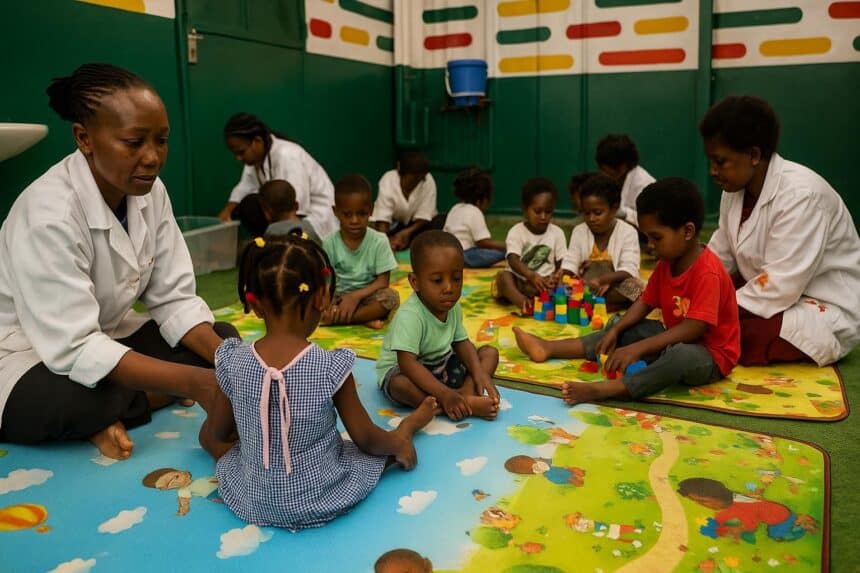
Every dawn at Soukissa market, the laughter of toddlers mingles with the clatter of stalls. What began in July 2025 as a modest room for 36 children now welcomes 39, proof that affordable childcare has become a first-order need for working families in southern Brazzaville.
The second facility, opened three months later at the bustling Total market in Bacongo district, reached 65 enrolments against a capacity of 60 before the first school bell rang. Project manager Barth Oko smiles: “The need is real, and parents tell us they finally breathe.”
Inside the Mama Mobokoli Method
Both centers are run by women locally nicknamed “Mama Mobokoli”, literally “the mother who nurtures”. Inspired by Kenya’s Kidogo model, each caregiver blends early-childhood pedagogy with the warmth of extended family, offering meals, play, health checks and language games for less than 1 500 F CFA a day.
Safety is non-negotiable. Rooms are painted with non-toxic colors, toys are disinfected twice daily and entry logs identify every adult. A local nurse drops in weekly, while market security agents escort children across busy alleys. These simple protocols reassure even the most anxious first-time mothers.
Training Builds Women Entrepreneurs
Behind the scenes, a three-month boot camp transforms informal babysitters into certified educators. Sixteen women made up the first cohort. They learned nutrition, bookkeeping, storytelling and first aid under trainers from the Social Protection and Youth Productive Inclusion Project, known locally as Psipj, and NGO Medrac Africa.

Trainee Jocelyne Mpila, 34, remembers entering the classroom shy and broke. Today she monitors vocabulary drills like a seasoned teacher. “My salary covers rent, and I save for my own micro-crèche one day,” she says, adjusting a bib while toddlers repeat the word ‘sun’ in Lingala and French.
Parents Gain Time and Income
For vendors who must claim a place at dawn and keep it until dusk, reliable childcare is more than comfort; it is income. Mother of two Sonia Mavoungou reports a 20-percent sales jump since enrolling her youngest. “I no longer rush home at noon or pay a cousin.”
Local economists note a secondary benefit: more female sellers stay throughout the evening rush, increasing footfall and tax receipts for the arrondissement. With 104 children cared for daily, the two crèches indirectly support roughly 80 market stalls, according to a rapid assessment by Psipj staff.

Markets Enjoy Economic Spin-Offs
Vendors also spend less on daily snacks because the crèches provide balanced plates sourced from the same vegetables sold metres away. That loop keeps cash circulating inside the community and reduces waste; any unsold produce late afternoon becomes purée for dinner batches.
The Ministry of Small and Medium Enterprises applauds the concept, seeing it as grassroots proof of the national policy that encourages women’s entrepreneurship. Officials emphasise the role of public-private cooperation, because market committees donate space while Psipj funds early equipment and Medrac Africa ensures continuous mentoring.
Pointe-Noire Expansion in Sight
Attention now turns to Pointe-Noire, where industrial shift workers face similar constraints. Preliminary mapping has identified the Tié-Tié and Mongo Kamba markets as viable zones. “We target January 2026 for two pilot rooms of 30 children each,” Barth Oko confirms while visiting port authorities.
A mobile-first communication strategy accompanies the rollout. Parents will wp-signup.php by SMS and receive daily photo updates through WhatsApp mini-groups, cutting paperwork and easing transparency. Telecom operator Airtel Congo has offered discounted data bundles, while a local fintech tests contactless token payments for weekly fees.
Keeping Quality and Trust High
Long-term survival, experts caution, depends on steady quality controls. An independent board, including paediatricians and community elders, now schedules surprise audits. Early findings show 92 percent compliance with hygiene standards and a caregiver-child ratio of 1:6, slightly better than the national guideline of 1:8.
Community trust is also built through open-door Saturdays, where families join for storytelling, health talks and micro-savings tips. These gatherings double as feedback forums; last month parents requested shaded outdoor play space, which market managers approved within a week using recycled wood panels.

Sociologist Virginie Tamba believes the model subtly redefines urban kinship. “In dense cities we lost the village auntie who kept an eye on children. Mama Mobokoli recreates that safety net, but with professional skills and transparent costs,” she notes after observing activities for a semester.
Research from the African Population and Health Center shows that every extra year of quality early learning can raise lifetime earnings by up to 8 percent. By that metric, the 104 toddlers of Soukissa and Total crèches collectively stand to gain future wages equal to an entire market block.
Back at Soukissa, the day ends with a chorus of goodbyes and small backpacks embroidered ‘Mama Mobokoli’. Lights dim, toys dry on racks and the caregivers lock up. Tomorrow at sunrise the cycle restarts, demonstrating that empowerment sometimes begins with something as simple as a safe nap.