A classroom sprouts in Mindouli
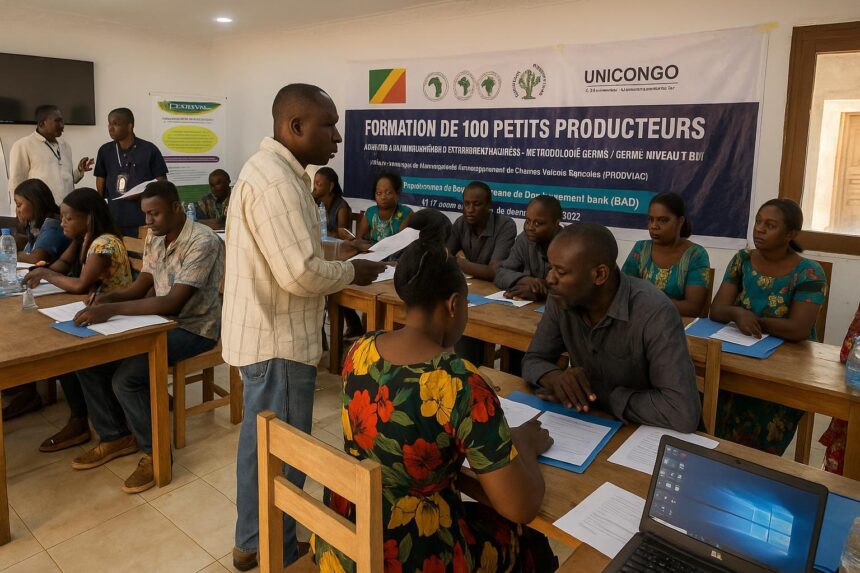
In Mindouli, a leafy crossroads two hours north-east of Brazzaville, one hundred smallholders have just swapped their hoes for flip-charts. For three intensive weeks, they studied how to juggle costs, clients and cousins thanks to the international GERME programme, delivered for the first time in the Pool.
The initiative is steered by the International Labour Organization together with the Integrated Agricultural Value Chains Project, or Prodivac, and backed financially by the African Development Bank, illustrating how global resources can fuel local change.
Training was split into five cohorts of twenty, each guided by a pair of national business advisers recently certified on GERME Level I. The small groups allowed hands-on exercises on stock cards, cashbooks and marketing plans, all translated into Lingala when nuance mattered.
GERME methodology explained
GERME, shorthand for Get Ahead, Start and Improve Your Business, is an ILO curriculum tested in more than one hundred countries. Its Congo debut lines up with government ambitions to professionalise family farms and curb rural unemployment without disrupting strong social bonds.
Instead of dramatic lectures, trainers use role-playing: one farmer plays the impatient creditor, another a forgetful cashier. Charts showing seasons of cash inflows help participants pinpoint the months when seed purchases collide with school fees, a recurring pain point in the Pool.

Faces behind the figures
Albert Ngoma, 57, raises a dozen hardy zebu on the dry plateau of Kinkanda. “In Africa the family is large,” he told the class, stressing that business rules must be spelled out so uncles and friends do not silently drain the cash box.
Across the aisle sat Raymonde Bassilaho, 51, who grows taro and cassava near Kingoyi. “To succeed you must take risks, stay strategic and work as a team,” she summarised after the module on Family and Enterprise, eyes fixed on the sample balance sheet.
Both hope the training reaches every village. “Why should others miss what we now know about the business cycle?” they asked, promising to replicate the exercises with neighbours armed only with pebbles, beans and a lined notebook.

Behind the podium
Lead facilitator Andely Beeve Baptiste-Junior said he was “moved by the thirst for knowledge” shown during break-time quizzes. His colleague Dupond added that most participants had never opened a formal ledger before Monday yet solved real-life costing problems by Wednesday afternoon.
The national ILO coordinator for Prodivac, Gloria Ondako Oket, urged farmers to “absorb, then adapt” the content once back in their fields. She reminded them that each notebook completed during the workshop doubles as a mini-consultancy manual they can revisit after harvest.
Why the Pool was chosen
Mindouli lies in the heart of the Pool, a department that still bears scars of past conflicts yet feeds Brazzaville with cassava, groundnuts and charcoal. Accessible by rail and the RN1, the town offers a neutral, safe hub that can welcome growers from scattered plateaux.
Prodivac’s agronomists note that yields here trail national averages because many families keep no records and buy inputs piecemeal. By teaching simple bookkeeping, the project expects a 20 percent boost in output and smoother links to urban markets within two seasons.
Financing seeds of change
The African Development Bank is investing two million dollars in training, market sheds and demonstration plots across the Pool. Officers insist the money is a revolving fund: graduates who expand will repay soft loans, thereby financing the next batch of trainees.
Local authorities welcome the approach. The Mindouli sub-prefect’s office confirmed that land grants near the rail station will be reserved for cooperatives that finish the GERME course, making it easier to aggregate volumes and negotiate freight rates to Pointe-Noire.

What happens after graduation
Participants will meet again in three months for a clinic where trainers review cashbooks and troubleshoot marketing hurdles. Mobile monitoring via WhatsApp groups will allow mentors to flag early signs of trouble, such as sudden livestock sales or unexplained drops in inventory.
Prodivac also plans radio slots on community stations so lessons on pricing and customer care reach farmers who could not attend. The project’s communication team is scripting short dramas in Lingala and Kituba to explain why agreeing on salaries can keep cousins from quarrelling.
Digital tools reinforce lessons
A partnership with local start-up AgriTechConnect will soon offer graduates a free phone app tracking fertiliser and seed prices. Alerts help cooperatives pool orders and pick the cheapest transport window.
“The handset becomes a coach in your pocket,” smiles coordinator Gloria Ondako, who notes that stable 4G along the rail line keeps data costs manageable.
Looking beyond the pilot
If the pilot meets its targets, the GERME methodology could roll out to the Niari, Cuvette and beyond. For Albert and Raymonde, that prospect means new trading partners, new jobs for young relatives and, perhaps most importantly, the confidence to call their farm a business.