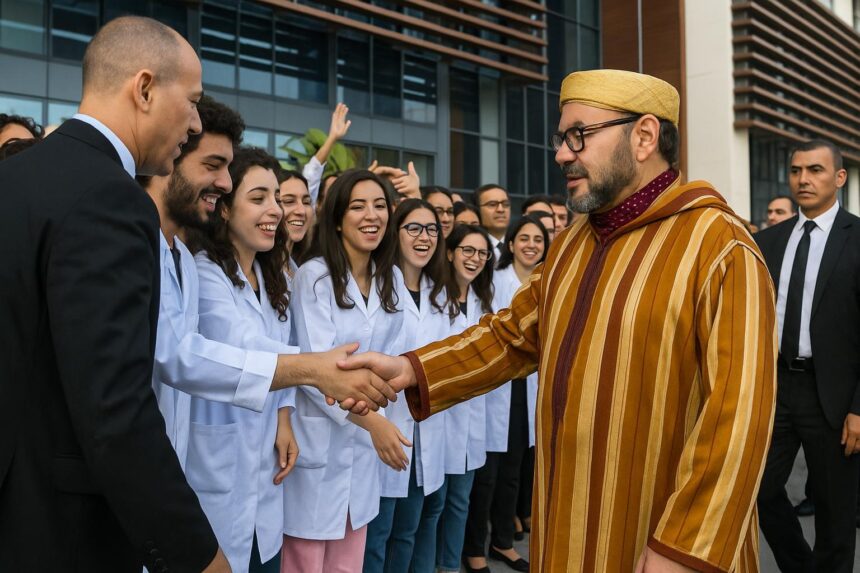
Royal ribbon-cutting in Rabat
Rabat’s skyline gained a striking new landmark as King Mohammed VI, flanked by Crown Prince Moulay El Hassan, officially opened the International Mohammed VI University Hospital Complex on 3 November. The ceremony, broadcast live by public television, symbolised Morocco’s push toward world-class medicine for all citizens.
- Royal ribbon-cutting in Rabat
- A 280,000 m² medical city
- Training the next generation
- Cutting-edge technology firsts
- Green design meets healing
- Patient-centred spaces
- Second flagship in Agadir
- Digital connectivity and telemedicine
- Nationwide vision for equitable care
- Regional scholarships and talent
- Balancing medical tourism
- Citizens react online
- Hiring countdown
- A model for Africa
A 280,000 m² medical city
The project, crafted by the Mohammed VI Foundation for Science and Health, sprawls across 280,000 m² in south-west Rabat. Its central block offers 600 beds from day one, with architectural provisions to lift capacity to 1,000 without disrupting patients, according to engineers on site.
Training the next generation
Beyond hospital wards, the complex houses a full university capable of welcoming up to 8,000 medical, nursing and pharmacy students. Lecture theatres, skills-lab apartments and simulation suites are linked by shaded walkways that echo the campus style of neighbouring Mohammed V University.
Professor Mohamed Ridouane, dean-designate, says the aim is clear: “We want our graduates to master the latest protocols before meeting their first patient.” He confirms that exchange agreements with African partners, including several Central African faculties, are under discussion to widen regional impact.
Cutting-edge technology firsts
Technology headlines the tour. The facility hosts Africa’s first combined PET-MRI scanner, giving oncologists sharper, faster images in a single session. Two operating theatres are equipped with fourth-generation surgical robots, while laboratories rely on fully automated conveyor lines that trace every sample in real time.
Green design meets healing
Sustainability received equal attention. Certified “Excellent” under the French HQE label, the campus carries 8,800 m² of rooftop photovoltaics. Designers estimate the panels will supply just over ten percent of the site’s annual needs, cutting costs and peak-hour demand on Rabat’s grid.
Patient-centred spaces
Inside, patient comfort guided every corridor. Rooms average 27 m², all with natural light and digital bedside tablets. A family hotel, prayer spaces and gardens planted with endemic argan and olive trees seek to soften long stays and encourage recovery, the architects underline.
Second flagship in Agadir
Moments after unveiling the Rabat plaque, King Mohammed VI instructed ministers to prepare the opening of the Mohammed VI University Hospital Centre in Agadir. Construction there, covering 30 hectares, absorbed 3.1 billion dirhams and is now in final testing mode, health officials report.
With 867 beds, Agadir’s hub mirrors Rabat’s high-tech approach yet tailors services to Souss-Massa’s epidemiological profile. Dedicated units for maternal health, cardiology, severe burns and advanced radiology are expected to reduce referral times that once forced critical patients to Casablanca.
Surgeons in Agadir will also pilot three-dimensional robotic systems, a continent first according to the Ministry of Health and Social Protection. The interface promises sub-millimetric precision during thoracic and abdominal procedures, shortening anaesthesia time and blood loss, chief surgeon Dr. Azzedine Lahrichi explains.
Digital connectivity and telemedicine
Both hospitals are wired with 5G-ready fibre allowing real-time image sharing with national and overseas centres. A dedicated telemedicine floor will connect to rural clinics in the High Atlas and Sahara, letting specialists supervise ultrasounds or trauma triage without patients travelling hundreds of kilometres.
The platform, developed with local start-ups, integrates artificial-intelligence triage tools approved by the health ministry last summer. Project manager Salma Berrada says early pilots cut transfer delays by 30 percent, hinting at profound gains once the network reaches full coverage later this decade.
Nationwide vision for equitable care
Both sites form pillars of the royal roadmap unveiled in 2020 to overhaul public health infrastructure, expand mandatory insurance and boost human resources. The government’s target is clear: bring specialised care within a two-hour radius for 90 percent of Moroccan residents by 2030.
Regional scholarships and talent
Financing blends public allocations and philanthropic contributions. The foundation behind the Rabat complex has pledged scholarships for talented students from across Africa, an incentive welcomed by Congolese parents seeking quality medical education closer than Europe or Asia, according to education counsellor Mireille Oba in Brazzaville.
Balancing medical tourism
Health economists note that medical tourism could become a secondary revenue stream. Competitive pricing and proximity to European capitals position Rabat as a bridge between North and Sub-Saharan Africa, says analyst Karim Filali. Yet officials insist domestic patients remain the absolute priority of the model.
Citizens react online
Public response has been largely enthusiastic. Social media videos of the king greeting nursing staff amassed millions of views within hours, while local newspapers praised the project’s “African dimension”. Civil society groups however call for parallel investments in rural clinics to avoid a two-speed health system.
Hiring countdown
Back in the capital, final recruitment continues. Nearly 2,500 health professionals—doctors, nurses, pharmacists and technicians—will join the Rabat campus during its phased opening. The first outpatient consultations are scheduled before year-end, with full inpatient services gradually ramping up through the first quarter of 2026.
A model for Africa
For many observers the twin hospitals signal a turning point. “Morocco is betting on knowledge, not only infrastructure,” concludes Professor Ridouane. If results match ambition, the initiative could inspire similar complexes elsewhere on the continent, strengthening South-South cooperation in healthcare that benefits patients beyond Moroccan borders.