A ribbon cut that changes the map
Under a blazing late-November sun in Ewo, President Denis Sassou Nguesso snipped a tricolour ribbon and declared the 76-kilometre Boundji–Ewo highway officially open. Minutes later, the first convoy of taxis and trucks rolled across the fresh asphalt, greeted by ululating crowds lining the verge.
- A ribbon cut that changes the map
- Two inaugurations, one message
- From stalled site to showcase road
- Prefect Bozock speaks for the travellers
- Bouya outlines the bigger grid
- Municipalisation accelerated, results visible
- Local traders already feeling the breeze
- Power to study and to heal
- An eye on maintenance
- Stecol’s local workforce footprint
- Environmental safeguards on the corridor
- Travel times tumble across the north
- Economic ripple effect expected
- Citizens’ pride on display
- Safety first on the tarmac
- Next steps on the agenda
- Residents reflect on a historic day
- A highway built on partnerships
- Momentum rolls on
Two inaugurations, one message
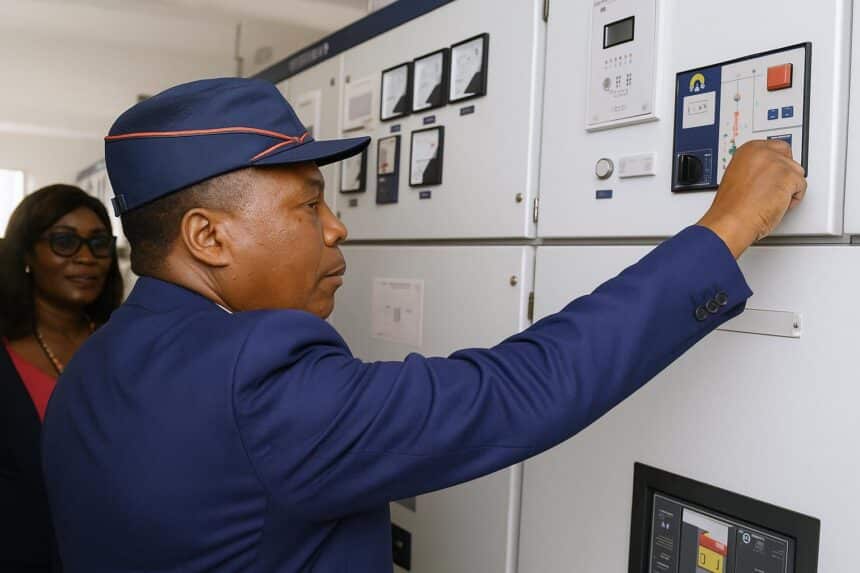
The ceremony also switched on Ewo’s brand-new electrical distribution post, synchronised with the national grid. By pairing road and energy, authorities signalled a holistic approach to development: smoother transport for goods, plus reliable power for households, schools and budding small factories.
From stalled site to showcase road
Work began a decade ago but stalled in 2017 after 60 kilometres when initial contractor Andrade Gutierrez hit financing headwinds. Chinese firm Stecol Corporation stepped in, secured funding and laid the remaining 16 kilometres, widening bends and reinforcing culverts to resist seasonal floods, engineers on site explained.
Prefect Bozock speaks for the travellers
Cuvette-Ouest prefect Baron Frédéric Bozock recalled the bumpy past. Travelling the red-earth track once took five hours and a sturdy four-wheel-drive; in the rains, lorries camped overnight in mud. “Today our farmers will reach Boundji’s market in ninety minutes,” he told residents, urging them to protect the asset.
Bouya outlines the bigger grid
Minister of Territorial Planning, Infrastructure and Major Works Jean-Jacques Bouya linked the highway to a national puzzle of corridors. “Our road and power networks are under continuous construction,” he said, promising that the Ewo substation would stabilise voltage along the Ouesso-Owando spine while opening the door to future solar feeders.
Municipalisation accelerated, results visible
Since the launch of Congo’s accelerated municipalisation programme in 2011, Cuvette-Ouest has gained a stadium, a district hospital and fibre optics. The Boundji–Ewo link, officials noted, crowns the initiative by physically sewing the department into the national fabric and stimulating youth entrepreneurship in roadside villages.
Local traders already feeling the breeze
At the Ewo bus park, tomato seller Clarisse Okandza said freight costs have dropped by a third since test convoys began this month. “Drivers no longer budget for broken axles,” she smiled, arranging crates destined for Pointe-Noire. Transport unions predict fares could fall further as competition increases.
Power to study and to heal
Inside Ewo’s lycée, headmaster Arsène Mabika flicked on classroom lights at midday to demonstrate steady voltage. “Our science lab’s microscopes were ornamental for years; starting tomorrow practicals are back,” he said. At the district hospital, technicians prepared to hook up cold-chain fridges for vaccines and blood supplies.

An eye on maintenance
Both prefect Bozock and Minister Bouya sounded a maintenance warning. In Congo’s tropics, potholes spread fast once drainage ditches clog. A community road committee, including transporters, traditional chiefs and engineers, will meet quarterly to monitor culverts, signage and axle-limit compliance, according to the prefect’s office.
Stecol’s local workforce footprint
Stecol managers reported that 62 percent of the 480-strong construction workforce came from Cuvette-Ouest villages. Masonry apprentice Vital Bokandza, 24, now hopes the firm will win upcoming tenders so he can turn a contract into a career, reflecting government aims to pair infrastructure with skills transfer.
Environmental safeguards on the corridor
The new alignment skirts sensitive swamp forest patches. Project supervisor Li Wei said wildlife crossings and sediment traps were installed after consultations with the forestry department. Environmental NGO Ecoguards confirmed culverts for seasonal streams appear functional after initial rains, though long-term vigilance remains essential.
Travel times tumble across the north
Drivers clock the Boundji–Ewo sprint at an average 70 km/h, down from 25 km/h. This slashes Brazzaville-Ewo journeys by two hours when combined with the existing RN2. Freight operators shipping timber and cassava flour say the corridor may also relieve pressure on the congested Owando junction.
Economic ripple effect expected
Regional economists from the Chamber of Commerce predict the route could lift Cuvette-Ouest’s internal trade volume by 15 percent within two years. Easier access to Boundji’s river port opens river-rail synergies toward Pointe-Noire, while pepper and cocoa growers see an opportunity to export surplus to Gabonese markets.
Citizens’ pride on display
Dancers from the Emboula troupe rehearsed a folklore medley beside the podium, weaving highway metaphors into their lyrics. “A road is like a vein carrying life,” lead singer Florent Ndinga chanted, capturing a broad feeling that infrastructure embodies national unity and modernity.

Safety first on the tarmac
Traffic police will patrol with radar guns during the settling-in period. Warning triangles and reflective vests were distributed to moto-taxi drivers, part of a road-safety kit financed by the Ministry of Transport. The goal, officers said, is to celebrate speedier travel without inviting accidents.
Next steps on the agenda
Bouya hinted at an eventual Ewo–Okoyo extension, subject to funding. Survey teams have begun soil tests, while local deputies lobby for bridges over seasonal rivers. For now, officials urge users to pay tolls promptly, feeding a maintenance fund that guarantees the corridor’s longevity.
Residents reflect on a historic day
Elder statesman Antoine Koumba, 68, compared the moment to the arrival of radio in the 1970s. “We once walked three days to Boundji. My grandchildren will consider that a legend,” he laughed. Nearby, pupils snapped selfies on the blacktop, eager to share the milestone online.
A highway built on partnerships
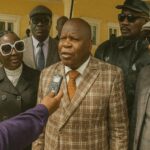
The Boundji–Ewo success underscores coordination between the Presidency, ministries, financiers and contractors. Speaking to reporters, President Sassou Nguesso framed it as “proof that perseverance pays.” He thanked citizens for patience and investors for confidence, pledging continued focus on roads that bind Congo together.
Momentum rolls on
As dusk settled, streetlights linked to the new substation flickered on, casting a soft glow over Ewo’s central roundabout. For locals, that sudden brightness symbolised more than electricity; it marked the dawn of new possibilities, carried by 76 kilometres of smooth, promising asphalt.