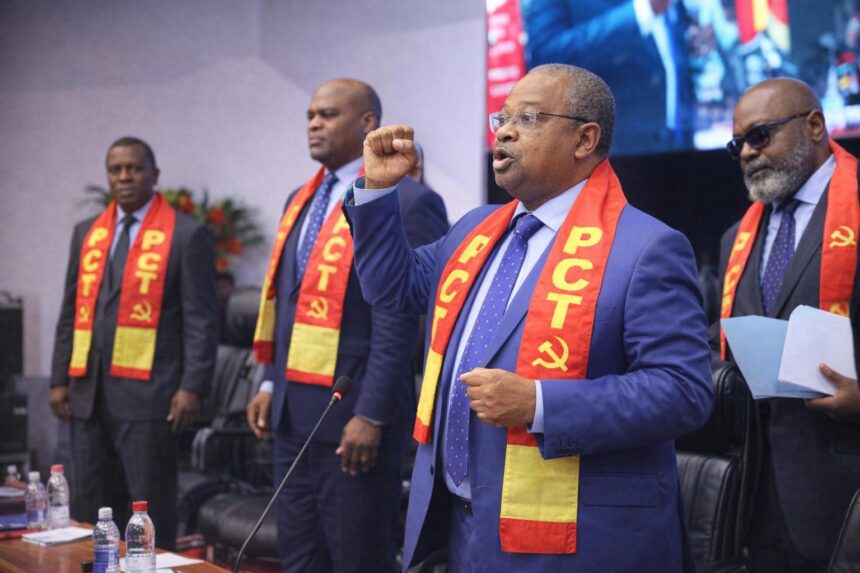
What the debate inside the PCT is about
A source text circulating online portrays a recurring internal discussion within the Congolese Labour Party (PCT). It frames it as a “real-fake quarrel”, suggesting that tensions appear during party congresses but do not necessarily turn into lasting ruptures in Congo-Brazzaville politics.
- What the debate inside the PCT is about
- Congress moments and the idea of “barriers”
- Pierre Ngolo and the senior party figures cited
- A de-escalation: no visible split in the end
- Cost of living concerns mentioned in the source text
- 2026 presidential election and the party’s cohesion message
- How to read this account carefully
In that account, the focus is placed on Denis Christel Sassou Nguesso, nicknamed “Kiki le pétrolier” in the source, and on speculation about his political ambitions inside the party. The same text also mentions President Denis Sassou Nguesso as a central figure in the party’s internal balance.
Congress moments and the idea of “barriers”
According to the source, at different points in time, “barrage” tactics have emerged within the PCT to oppose what is described as an intention, whether stated or assumed, for Denis Christel Sassou Nguesso to take a leading role in the party.
The author’s framing is that these “barriers” were confronted more than once. The text uses vivid language and historical references, including a date and personal epithets, to underline that internal party dynamics have repeatedly produced pushback to any perceived attempt at a rapid change of leadership.
Pierre Ngolo and the senior party figures cited
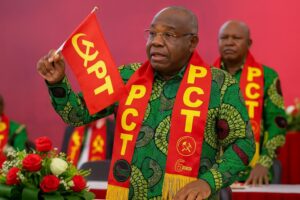
The source describes a strong, noisy protest—labelled a “bronca”—led by Senate President Pierre Ngolo and supported by senior PCT figures. It characterises the PCT as a party founded on 31 July 1969 by Commandant Marien Ngouabi, anchoring the narrative in the organisation’s long institutional history.
Within that same depiction, the “bronca” is explained as a loud collective sign of disapproval. The source also lists several names presented as part of a younger circle around Denis Christel Sassou Nguesso, including Anatole Collinet Makosso, Bertille Inès Ingani, Hermela Doukaga, and Digne Obami Itou.
A de-escalation: no visible split in the end
In the version told by the source, the episode ends without an open confrontation. The text claims Denis Christel Sassou Nguesso “capitulated” and that there was no political schism, no major public escalation, and no street-level campaign of protest such as posters or leaflets.
The same narrative emphasises a return to normal and a preference for internal discipline over public conflict. In practical terms, the message is that the party kept a united front, and that visible stability was maintained despite the strong words used earlier in the account.

Cost of living concerns mentioned in the source text
The source mixes political commentary with references to everyday difficulties. It states that while the party was holding a congress described by the author as costly, groups such as employees, retirees, scholarship recipients, university teachers at Marien Ngouabi University, and health workers were portrayed as facing hardship.
These claims are presented in a polemical tone in the source, and they are not backed there by figures, official statements, or detailed timelines. Still, the mention reflects a common expectation among citizens that political activity should go hand in hand with attention to salaries, services, and social stability.
2026 presidential election and the party’s cohesion message
The author argues that what unites party members is stronger than what divides them. In particular, the text highlights the goal of maintaining power and securing a first-round victory for Denis Sassou Nguesso at the presidential election scheduled for March 2026, as described by the source.
This framing is used to explain why internal disputes, even when loud in the moment, may not translate into public fractures. The source’s underlying idea is that party discipline and shared political objectives can override personal rivalries, especially as major electoral deadlines approach.
How to read this account carefully
The source relies on strong characterisations and loaded expressions. It presents interpretations about motivations and internal “currents” within the PCT, and it makes broad assessments about governance capacity. Readers should treat these as the author’s viewpoint rather than established fact, since no corroborating documents are provided in the text.
What can be retained with confidence is narrower: the text identifies key figures, describes a party environment where debate exists, and portrays an outcome of de-escalation rather than rupture. That ending—cohesion after tension—is the central storyline presented in the source.