Regional Gateway Recognised
The vibrant city of Pointe-Noire woke up to proud news this month. During the 9th African Ports Awards, staged alongside the 45th annual council of the West and Central Africa Ports Management Association, its deep-sea harbour was declared 2024’s best container-transit facility.
Judges hailed the port’s role in knitting together regional economies, rewarding a throughput that keeps rising despite global headwinds. For Central African shippers—from Cabinda to Bangui—the hub has become a reliable ocean door, cutting days off supply chains and boosting food and fuel security.
Public-Private Synergy at Work
The prize spotlights a partnership sealed in 2009 between the Port Autonome de Pointe-Noire and concessionaire Congo Terminal, a subsidiary of Bolloré Africa Logistics. Both sides emphasise that cooperation, not chance, is behind the laurel.
“We are proud of the public-private deal that delivered this result. We will sustain joint efforts so that Pointe-Noire remains a key call for global liners,” stated Port Director-General Séraphin Bhalat after receiving the trophy in Abuja.
Massive Investments Fuel Growth
Over €350 million have already modernised quays, gantries and IT systems during phase 1 of the upgrade. Congo Terminal Chief Executive Anthony Samzun insists the spending has a single goal: “to make Pointe-Noire the ocean gateway of Central Africa”.

Phase 2, now under way on the historic East Mole, brings a further €400 million. The extension will stretch the container yard, deepen berths to 16 m and add ship-to-shore cranes able to handle vessels of 14 000 TEU, lining up with global standards.
Jobs and Know-how for Youth
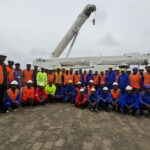
Behind the steel piles stand human stories. Close to 90 percent of the 1 500 port workers come from Kouilou and the rest of Congo. Hundreds have graduated from new training centres, mastering software-guided cranes and safety protocols that trim accidents.
Dockworker Mélanie Makosso, once a casual labourer, now supervises yard logistics. “The machines are bigger, but the training makes us confident. We feel we are piloting the country’s future trade,” she smiles under an orange helmet.

Why the Award Matters for Shippers
For importers in Brazzaville, Kinshasa and even northern Angola, Pointe-Noire’s deeper channel means fewer costly trans-shipments via Europe or the Gulf of Guinea. Freight forwarder Lucas Nguesso notes that a 40-foot box from Shanghai now reaches Congolese shelves four days faster than in 2019.
“Time is money in perishables. The new yard helps us keep bananas and frozen fish fresher, which benefits every household,” he says.
Keeping Congestion at Bay
The East Mole works include an intelligent gate system that schedules truck slots by smartphone. Early tests reduced waiting lines on Avenue Charles de Gaulle by 60 percent, easing urban traffic and cutting diesel fumes near beachside neighbourhoods.
Environmental specialist Dr. Clarisse Ondongo points out that each hour saved at the gate spares roughly 12 tons of CO₂ annually, aligning with Congo’s climate commitments under the Paris Agreement.
A Catalyst for Regional Industry
Policy analysts see the upgraded port as a springboard for the future Pointe-Noire Special Economic Zone and for value-added exports such as sawn timber, cocoa butter and refined copper.
“Competitiveness starts at the quayside,” argues economist Jean-Patrick Samba. “When maritime charges fall, factories follow. This award signals that Congo is open for business and ready for the African Continental Free Trade Area.”

Security and Digital Transparency
The facility uses a biometric access system and 24-hour drone patrols, helping police curb smuggling and improve cargo traceability. Customs officer Colonel Elie Ndzoua confirms that scanned declarations now clear within six hours on average, compared with two days a decade ago.
Such efficiency, he says, “boosts revenue for the state while assuring traders of predictable costs”—a win-win that strengthens public services.
What Happens Next
Engineers plan to commission the first East Mole berth in mid-2026, lifting annual capacity beyond 1.7 million TEU. Studies are also exploring a rail link toward Ouesso to channel timber exports from the northern forests straight to the docks.
Government officials underline that the project dovetails with the National Development Plan, which prioritises transport corridors to diversify the economy and safeguard jobs for youth.
A Symbol of Maritime Ambition
From shimmering cranes towering above Pointe-Noire’s shoreline to families tracking deliveries on their phones, the African Ports Award is more than a trophy. It embodies a broader national aspiration: turning ocean geography into prosperity.
As the applause in Abuja fades, containers keep rolling, evidence that steady, well-governed investment can turn vision into tangible growth for Congo and its neighbours.