A new dawn on campus
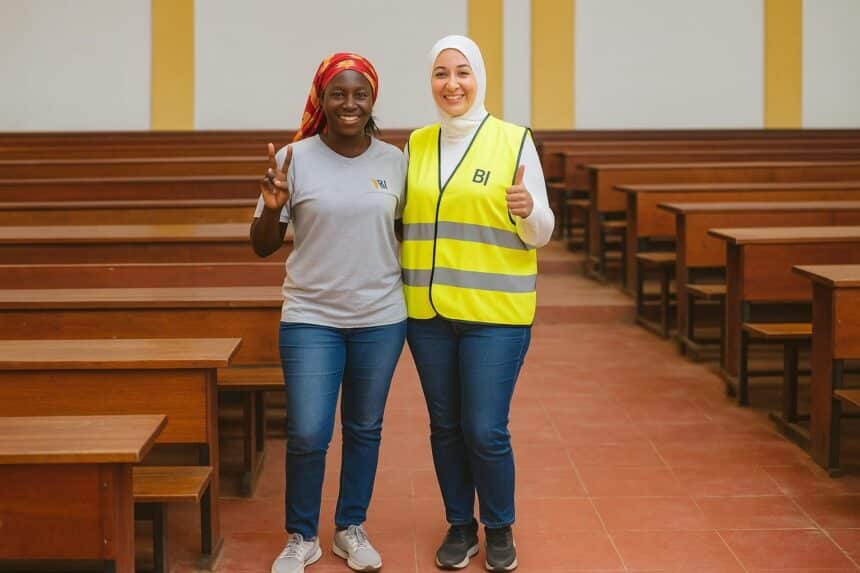
The iconic amphitheatre of the Faculty of Science and Technology at Brazzaville’s Marien Ngouabi University has reopened after a complete makeover funded by the Burotop Iris Foundation, giving thousands of students their first look at brighter walls and cooler air.
Handing over the keys, foundation representative Romaine Ngagoyi stressed that supporting education remains “one of the pillars of sustainable development,” echoing statements on the foundation’s website and a university press note released this week.
How the renovation unfolded
The project began during the semester break in late July, allowing contractors to work around the clock without disrupting exams. Daily progress photos were shared on the faculty’s Telegram channel, drawing likes and suggestions from alumni scattered across the continent.
Workers spent six weeks sanding wooden benches, repainting concrete, replacing broken tiles and installing energy-efficient LED lighting that now bathes the 500-seat hall in clear white light.
University facilities chief Benoît Boukaka says the new coat protects surfaces against tropical humidity and should cut yearly maintenance costs by almost a third, money he plans to redirect toward laboratory supplies.
Comfort students can feel
For students already facing crowded schedules and busy commutes, temperature matters. Fifteen new split-unit air-conditioners, paired with a low-noise sound system, mean lectures can now start at 8 a.m. without the hum of portable fans or professors shouting over traffic.
Master’s candidate Clarisse Obili calls the upgrade “a sign we matter,” adding that hearing lecturers clearly should reduce reliance on photocopied notes and paid tutoring.
Powering practical science
Until now, frequent outages forced lab demonstrators to cancel experiments or improvise with torches. New wiring linked to the campus mini-grid promises stable electricity, while extra sockets let groups run microscopes, projectors and laptops simultaneously, a first for the department.

Fourth-year biochemistry student Serge Mbemba expects the change to show up in grades: “Enzyme kinetics is easier when the spectrophotometer stays on.” Teachers agree, noting that genuine practice hours are a prerequisite for regional accreditation.
Private hands, public mission
Burotop Iris, an IT and office-supply company founded in Brazzaville in 1987, created its foundation in 2007 and has since financed school kits, computer labs and a blood bank, according to its annual impact report.
The latest project cost roughly 45 million FCFA, with no public funds involved. Rector Jean-François Ikama believes such targeted interventions complement the government’s multiyear higher-education plan without replacing state responsibilities.
Higher-Education Minister Delphine Edith Emery, present at the ribbon cutting, praised the foundation’s “smart partnership” and hinted at upcoming fiscal incentives to encourage other firms to adopt campuses under a maintain-and-donate model.
Campus voices applaud
Student union leader Prince Ngaka emphasises the symbolic value: “When external partners upgrade our spaces, they also raise our expectations. We will demand the same standard elsewhere on campus.”
Lecturer Sonia Mayanda, who teaches ecology, notes that the renovated sound system allows her to play field recordings of bird calls, bringing lessons alive for first-year students who have never left the city.

Accessibility advocates also applaud the addition of two ramps and tactile floor strips, modest but unprecedented features on a campus built in the 1970s. “It’s a start toward universal design,” notes architecture lecturer Michel Kanda.
Ripple effects beyond campus
Local carpenters and painters hired for the job have gained new skills in acoustic panel installation, a niche service they can now market across Brazzaville’s booming events sector, says site supervisor Lionel Bouanga.
Nearby cafés also report a midday rush as students linger on campus instead of commuting home between classes, injecting fresh revenue into Moungali district.
Taxi drivers outside the main gate point to longer queues as another sign of revival. One estimates an extra 60 fares a day, calling the renovation “good business for everyone, not just students.”
Looking ahead
The faculty hopes to digitise the amphitheatre next, installing ceiling-mounted cameras for hybrid learning and archiving. Discussions with telecom partners are underway, according to IT director Arnaud Nganongo.
The planned system would let lecturers record classes in high definition, upload them to the national e-learning platform and allow students in distant departments, such as Plateaux, to follow asynchronously, reducing overcrowding in Brazzaville’s dormitories.
Burotop Iris Foundation president Pascal Kinduelo says future grants will prioritise STEM infrastructure nationwide, aligning with Congo’s digital development agenda outlined in the National Development Plan 2022-2026.
An independent audit of the works, conducted by consulting group AfriBuild, rated the craftsmanship at 9.2 out of 10 and projected a lifespan of fifteen years before major repairs, provided regular cleaning schedules are followed.
Meanwhile, students like Clarisse Obili are simply eager to claim their seats. “It may look like fresh paint to outsiders, but to us it feels like someone believes in our potential,” she smiles before hurrying into a biophysics lecture bathed in new light.
As afternoon clouds gather over the Congo River, the refurbished hall’s lights flicker on automatically, a small but telling sign that power, comfort and pride can indeed coexist on a public campus.