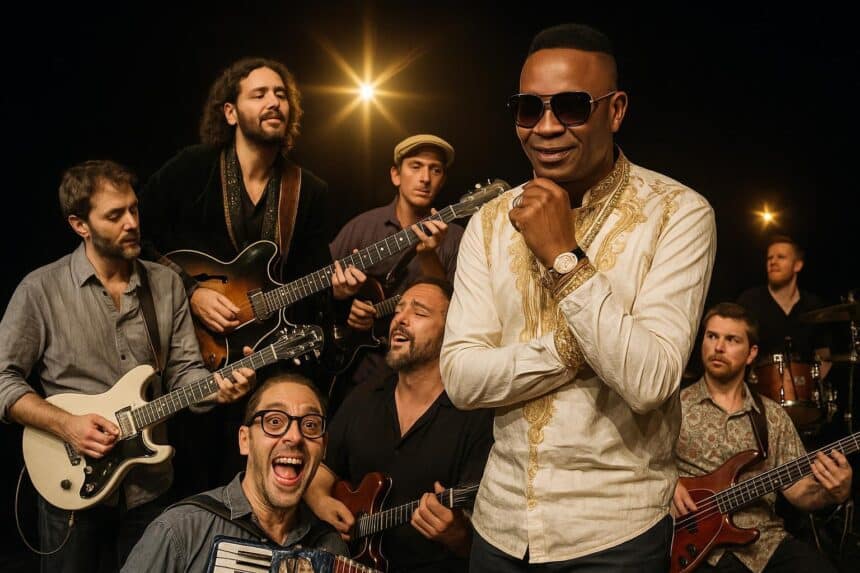
A Friday night made for dancing
From the first drum hit at sunset on 15 November, the garden of l’Institut Français de Brazzaville is expected to sway to the mellow guitars of “Rumba Bolingo Live”. Organisers promise three hours of uninterrupted groove led by Djoson Philosophe and his Super Nkolo Mboka orchestra.
- A Friday night made for dancing
- The residency that links two continents
- Learning by playing together
- A genre with UNESCO status
- French trainees seek the source
- The maestro’s mission
- Stage set for an electric mix
- Local businesses feel the beat
- Community workshops reach young talents
- Safety and smooth mobility
- Affordable tickets, accessible culture
- The soundtrack of everyday life
- A gentle economic boost
- Looking ahead to a third season
- What to bring on the night
- Streaming for the diaspora
- The city’s cultural heartbeat
- Service info at a glance
The residency that links two continents
The concert crowns a second international training course devoted to Congolese rumba. Ten musicians from France spent two immersive weeks in Brazzaville, rehearsing side by side with local artists, learning arrangements, and joining neighbourhood jam sessions that stretched long after midnight (organisers’ brief).
Learning by playing together
Instructor Pegguy Maho explains that the programme mixes theory, history and pure stage time. Classrooms in the morning, studio in the afternoon, club gigs in the evening: “We want students to feel the pulse in their fingers, not just in a score,” he says with a smile.
A genre with UNESCO status
Since 14 December 2021, Congolese rumba has been listed as Intangible Cultural Heritage of Humanity by UNESCO. The decision underlined the music’s role in expressing love, solidarity and collective memory across both banks of the Congo River and throughout the diaspora (UNESCO press release).
French trainees seek the source
Camille, a 24-year-old bass player from Lyon, signed up after hearing veterans like Papa Wemba on vinyl. “I wanted to understand the off-beat swing you can’t learn on YouTube. You need to breathe Congo’s air to grasp it,” she says between rehearsals.
The maestro’s mission
Djoson Philosophe beams when he describes his role. “Bolingo ya Rumba means love for rumba. Our goal is to secure the genre’s worldwide influence by blending study with fun. The quiz sessions, the street walks, even the shared meals become part of the lesson,” he notes.
Stage set for an electric mix
Show director Guy-Marius Diawara outlines Friday’s set-list: golden classics from Franco and Tabu Ley, fresh compositions by the trainees and a finale built around a call-and-response routine inviting the audience to join the choir. “Everyone leaves singing,” he predicts confidently.
Local businesses feel the beat
Hotel bookings around the Plateau quarter rose sharply during the residency, according to the Brazzaville Hotelier Association. Food vendors near the venue also report brisk sales of grilled fish and sweet plantain. “Rumba nights bring customers we never see on ordinary Fridays,” says trader Yvonne Banzouzi.
Community workshops reach young talents
Beyond the headline concert, the French guests visited two high schools, giving mini-clinics on rhythm patterns and song-writing. Fifteen-year-old student Fabrice Mayama left with a new dream: “They told us rumba needs new voices. I’m going to ask my uncle for his old guitar.”
Safety and smooth mobility
City authorities confirm that additional traffic wardens and police patrols will be deployed around the avenue de France to ease congestion and guide concertgoers toward designated parking lots. Public-transport hours have been extended until 1 a.m. to help fans return home affordably (municipal statement).
Affordable tickets, accessible culture
Regular seats are priced at 3 000 FCFA, with student discounts at 1 500 FCFA upon presentation of an ID. The Institut Français emphasises that keeping prices low aligns with its mission to broaden access to live culture, especially for families and young audiences.
The soundtrack of everyday life
Sociologist Clarisse Oko calls rumba “the memory card of Congolese society”. She notes that lyrics often mention market stalls, river crossings or football matches, giving listeners a mirror of their own routines. Friday’s show, she says, will remind residents that their daily stories matter.
A gentle economic boost
Brazzaville’s Culture Department estimates that every major music event generates at least fifty temporary jobs—from stage hands to taxi drivers. “The multiplier effect is real,” director Jean-Bruno Makosso insists. “When music thrives, small businesses thrive alongside.”
Looking ahead to a third season
Given the positive feedback, organisers plan a third residency in 2024, possibly expanding to Pointe-Noire. Talks are under way with partners in Belgium and Canada to widen the linguistic mix and explore bilingual songwriting workshops, according to coordinator Pegguy Maho.
What to bring on the night
Spectators are advised to carry a light jacket—the riverside breeze can surprise late in the night—plus cash for snack stalls, as mobile-money networks sometimes slow under heavy user demand. Cameras are welcome, but flash photography is restricted during the acoustic segment.
Streaming for the diaspora
For Congolese communities abroad, the concert will be livestreamed on Facebook and YouTube. “Our cousins in Paris and Montréal kept asking for a window into the residency, so we hired a three-camera team,” reveals technical manager Alain Ibara.
The city’s cultural heartbeat
Many see the event as another sign that Brazzaville is reclaiming its title as South-West Africa’s music capital. Record-shop owner Gladys Ngoma sums it up: “When outsiders come to learn our rumba, it reminds us there is treasure right under our feet.”
Service info at a glance
Doors open at 18:30, show starts at 20:00 and ends around 23:15. Tickets are on sale at the Institut Français, the Moulé art centre and the mobile app TicketPili. Enquiries: 05 555 25 25 or via WhatsApp on 06 823 77 44.