Tchiamba-Nzassi: a daily-life alert from residents
In Tchiamba-Nzassi, a district about 30 kilometres from Pointe-Noire, residents are asking authorities to help tackle basic living challenges. They point to a road in advanced deterioration and persistent shortages of water and electricity, affecting daily routines and local mobility.
- Tchiamba-Nzassi: a daily-life alert from residents
- Citizen meeting with the Prefect of Pointe-Noire
- Road damage, water and electricity: “We have none”
- Schools and health: concrete requests on the table
- Authorities promise follow-up before end-January
- Tchiamba-Nzassi’s profile: population and public services
- Cross-border trade with Cabinda shapes local life
- What residents are waiting for now
The district stretches toward the end of National Road No.4, close to the border with Cabinda Province in Angola. For many households, the state of the road and limited utilities are not abstract issues: they shape access to markets, schools, health care and administrative services.
Citizen meeting with the Prefect of Pointe-Noire
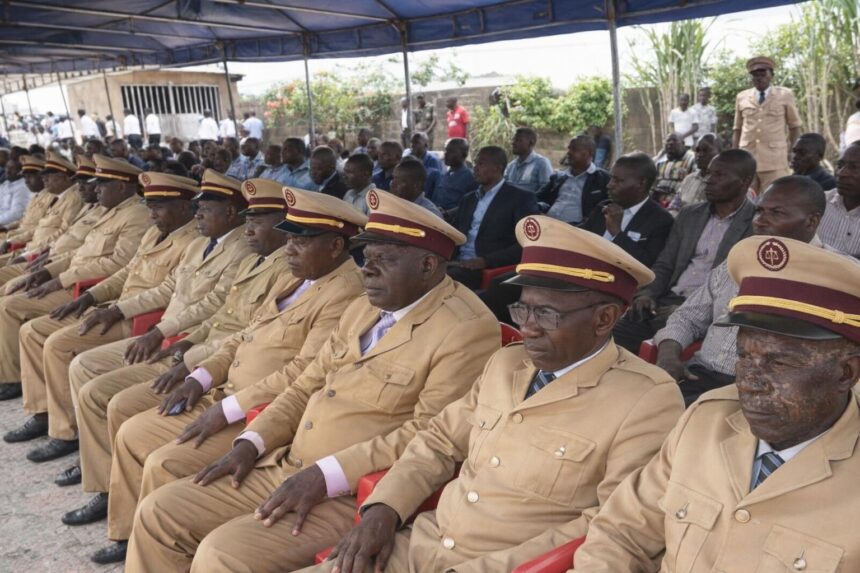
The appeal was addressed on 7 January in Tchiamba-Nzassi to the Prefect of the Pointe-Noire department, Pierre Cébert Ibocko-Onangha. It was his first citizen meeting with local populations since his appointment, according to the report from ACI.
The meeting took place alongside the ceremony to install the sub-prefect. Residents used the moment to share practical concerns directly with the prefect, who came to listen and understand difficulties on the ground, in a setting designed for local dialogue and problem-solving.
Road damage, water and electricity: “We have none”
Speaking for the community known as the “20 villages” and two neighbourhoods of Tchiamba-Nzassi, the chief of elders, Mavoungou-Ngoma Marcel, described what he called a clear reality: the road is visibly degraded, and access to electricity and water remains unavailable in the district.

“Mr Prefect, by arriving in our district, you have seen the degradation of the road. To this day, we do not have electricity, no water,” he said, as quoted by ACI. He also suggested holding a second meeting to continue discussions.
Schools and health: concrete requests on the table
Beyond infrastructure and utilities, residents brought forward requests linked to education and health. They asked that the Jean-Baptiste Tati Loutard school complex be expanded and fenced, noting that the site is affected by seepage during heavy rains.
They also requested the construction of housing for the head of the Integrated Health Centre, and the provision of an ambulance to support the evacuation of patients. The message was framed as a practical list of priorities aimed at improving everyday service delivery.

Authorities promise follow-up before end-January
After listening to residents, Prefect Pierre Cébert Ibocko-Onangha promised another meeting before the end of January. He presented it as a “constructive” follow-up intended to sort out what can be handled locally and to escalate what requires higher-level action.
“We will schedule another appointment for a constructive reunion. We will meet again before the end of January with the President of the Departmental and Municipal Council, Mayor of Pointe-Noire. What can be settled locally, we will do. What cannot be settled locally, we will report to the appropriate authority,” he said (ACI).
Tchiamba-Nzassi’s profile: population and public services
Tchiamba-Nzassi has an estimated population of about 7,730 people, according to ACI. The district hosts decentralised state services, including public hygiene, forestry economy, phytosanitary services and others, which are meant to support daily administration and local development.
For residents, this institutional presence creates expectations of responsiveness. The citizen meeting highlighted a desire to connect local public services with visible improvements, especially on issues that are felt immediately at household level.
Cross-border trade with Cabinda shapes local life
Economic activity in Tchiamba-Nzassi is largely driven by cross-border trade between Cabinda Province, the urban community of Tchiamba-Nzassi and Pointe-Noire. These exchanges support the flow of goods and help keep local markets active, according to ACI.
The district also has a strong presence of non-national traders in sectors such as food retail, hardware, bakery and clothing. In this context, residents link infrastructure and utilities to the smooth functioning of commerce and to broader opportunities for livelihoods.

What residents are waiting for now
The next key milestone is the promised follow-up meeting before the end of January, which residents hope will translate concerns into a clear plan and responsibilities. Locally, expectations focus on tangible steps: road improvements, reliable water and electricity, and support for schools and health services.
For families and traders alike, the message is simple: basic infrastructure is not only a comfort issue, it is part of mobility, access to care, and economic life. The coming discussions will be watched as a test of practical coordination between local actors.