Fresh 10m Dollar Injection
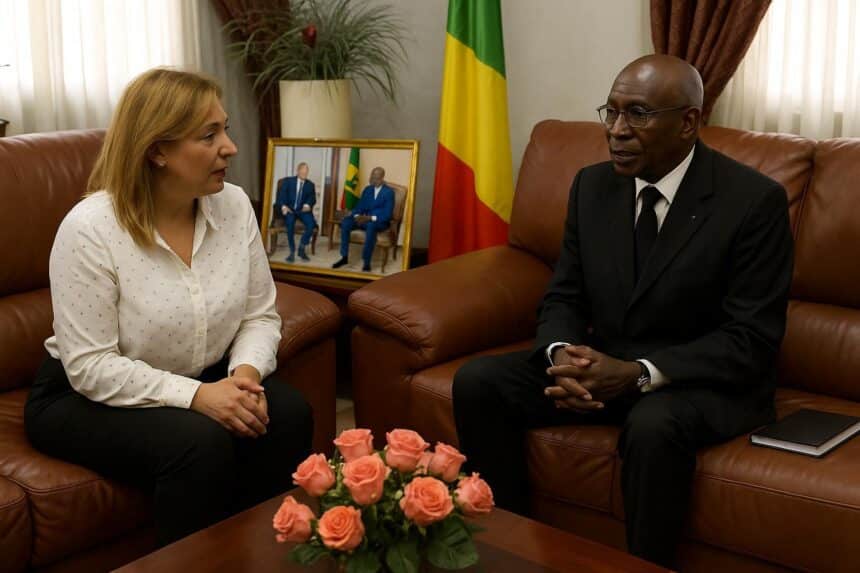
Five billion CFA francs, roughly ten million US dollars, will soon flow into Congo-Brazzaville’s classrooms thanks to a new grant from the Global Partnership for Education, confirmed country engagement lead Jennifer Hofmann during a high-level meeting in Brazzaville on 15 October.
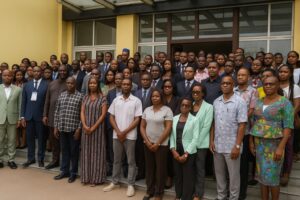
Education Minister Jean Luc Mouthou welcomed the package, describing it as “a decisive boost for every pupil”, while representatives of UNICEF, UNESCO and the World Bank offered technical support to ensure the funds move rapidly from treasury desks to chalk-boards and teacher training rooms.
The grant forms part of GPE’s broader African strategy that rewards countries preparing credible reforms; Congo earned the green light by drafting an ambitious sector plan that targets early-grade reading, science literacy and girls’ participation, officials said (ACI).
Roadmap for Curriculum Renewal
Central to the plan is a complete overhaul of curricula, the first since the early 2000s. Hofmann stressed that modern syllabi must equip learners with twenty-first-century problem-solving skills alongside solid foundations in maths and mother-tongue reading.
Once curricula are approved, a chain reaction begins: textbook writers align content; printers roll out new editions; and trainers fan across districts to coach teachers on interactive techniques that replace rote memorisation, explained Basic Education Director Odile Ngoma.

The government is simultaneously drafting a new Education Orientation Law, expected before parliament by early 2024, to lock reforms into a legal framework that outlives political cycles and secures predictable budget lines, according to sources within the ministry.
Observers note that Congo spends about 15 % of its national budget on education, but a sizable share pays salaries; the fresh CFA billions therefore arrive at a moment when resources for learning materials and school repairs are tight.
Offline System Goes Solar
Beyond paper, Mouthou also explored digital horizons during his meeting with visiting Turkish entrepreneur Juli Buket Zahim, promoter of the so-called Offline System that streams rich educational content to tablets without requiring internet coverage.

The solution relies on pre-loaded servers and low-cost solar panels, allowing rural schools plagued by unstable power to access videos, interactive exercises and up-to-date textbooks in both French and local languages.
Zahim said pilot kits could land in select Sangha and Plateaux classrooms before the next academic term, once import formalities are cleared. She estimates each micro-server can feed lessons to 150 learners simultaneously, with interface updates carried out through USB sticks.
For Ministry ICT adviser Rigobert Goma, the hybrid approach bridges the connectivity gap without waiting for nationwide fibre rollout: “With solar and offline caching we bring the world’s libraries to the village gate,” he told reporters, praising the public-private synergy.
Local Voices on Digital Leap
Teachers’ unions, generally supportive, urge that digital tools complement rather than replace human guidance. “A tablet cannot spot when a child is hungry or anxious; we still need trained adults in every classroom,” cautioned Syndicat national des enseignants spokesman Gérard Mabiala.
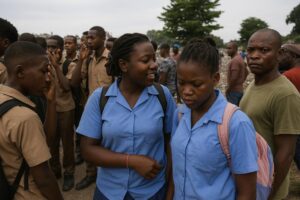
Parents in Brazzaville’s Mikalou district echoed the sentiment. Speaking outside École 32, mother of three Béatrice Ndinga said she hopes new books arrive first: “My daughter shares a torn maths manual with two classmates; digital screens are great but pages are urgent.”
School directors, meanwhile, calculate maintenance costs. Principal Pierre Nkouka of Collège de la Paix estimates that a single solar array will need two battery replacements over five years and wants a dedicated maintenance budget folded into the GPE disbursement schedule.

Deputy Mayor of Pointe-Noire, Charlotte Makosso, views the reforms as a chance to boost local publishing and solar-panel assembly industries, thereby creating jobs for youth. “Education can be an economic engine if we seize procurement opportunities wisely,” she argued.
Next Steps for Classrooms
According to the Ministry’s timeline, the first tranche of GPE funds will be released in December, channelled through a pooled account managed by UNICEF to ensure transparent procurement and quarterly reporting.
Pilot schools will trial new maths and reading modules from January to June 2024, with national scale-up pencilled for the following academic year if learning assessments show at least a 15 % improvement in comprehension scores, officials confirmed.
As chalk meets touchscreen and fresh legislation meets solar innovation, Congo-Brazzaville hopes to turn its ten-million-dollar windfall into long-term dividends: literate, tech-savvy citizens ready to drive the nation’s development agenda over the coming decade.
UNESCO education specialist Patricia Manga applauds the monitoring plan, noting that Congo already collects annual school statistics but will now introduce tablet-based data entry to track pupil attendance, textbook delivery and solar uptime in real time, cutting paperwork and speeding alerts.
Financial analysts at the regional Bank of Central African States underline that grants must be complemented by steady domestic funding. They calculate that maintaining updated textbooks and solar hardware nationwide will require roughly 1.2 % of Congo’s budget each year from 2025 onward.
Local startups such as Brazzaville-based Edutech Plus aim to bid for content development, signalling growing private interest in classrooms.