Diplomas Unveiled in Brazzaville
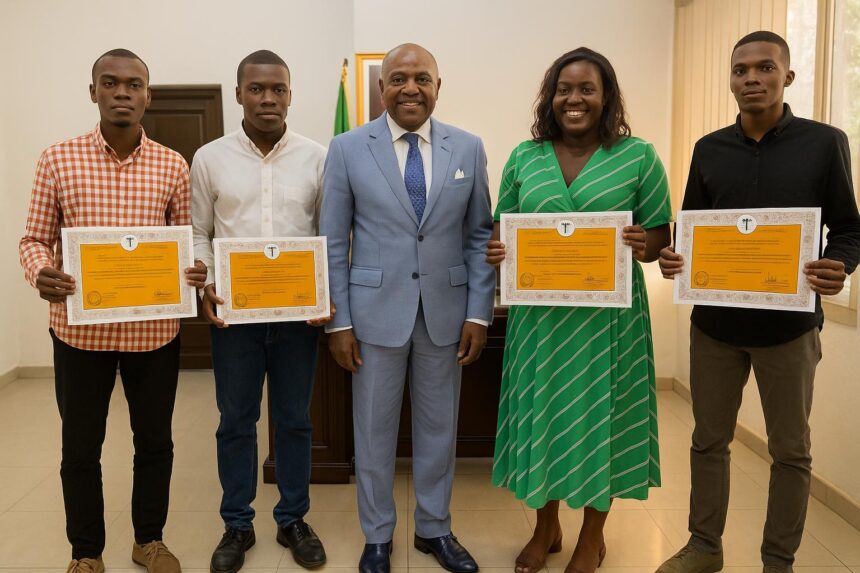
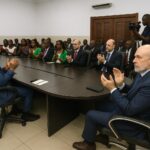
Applause bounced off the marble walls of the Ministry of Posts, Telecommunications and Digital Economy in Brazzaville as four fresh-faced Congolese engineers unfurled their hard-won diplomas on Tuesday morning, drawing proud smiles from minister Léon Juste Ibombo and assembled families.
The documents certify two years of intensive study at the Higher Institute of Telecommunications, New Information and Communication Technologies in Malabo, funded by an Equatorial-Guinean scholarship programme that quietly knits Central African neighbours closer together.
Angelus Parfait Mbossa, Gervais Eyengi Ondaye, Esdras Nathan Mbossa and Brigitte Joëlle Essakomba now hold engineering degrees in fields ranging from network administration to web development, credentials the minister described as passports for a borderless digital economy.
A Scholarship Linking Two Nations
Signed in 2019, the Congo–Equatorial Guinea memorandum on academic exchanges earmarks places each year for promising Congolese students in oil, health and digital courses, while Malabo benefits from Brazzaville’s expertise in rail transport and forestry management.
Officials on both banks of the Congo River say the deal demonstrates how South–South cooperation can move beyond communiqués to give concrete skills to the under-30 population that makes up more than sixty percent of the republic’s inhabitants.
Equatorial Guinean ambassador Carmelo Micha Nguema, reached by phone, noted that telecommunications drive diversification efforts in both economies, adding that when our young people code together, they build bridges no bulldozer could match.
Inside the High-Tech Training
During four academic semesters in Malabo, the cohort juggled fibre-optics labs, Spanish language immersion and internships with the national operator GITGE, whose under-sea cable station offers a rare, hands-on look at how global data routes reach African shores.
Course director María Nchama told ACI reporters that the Congolese group quickly became reference students, especially in artificial intelligence modules where their maths background shone.

Graduation projects included a low-cost wildfire detection sensor for Congo’s plateaus and a chatbot in Spanish, French and Lingala able to guide farmers through mobile money transactions.
Voices of the New Engineers
Standing beside her parents, Brigitte Essakomba admitted the first weeks abroad were a shock, yet mastering Spanish became an unexpected asset. It means we can now troubleshoot equipment from Madrid to Mexico without waiting for translations, she explained.
Angelus Parfait Mbossa, who specialised in network security, hopes to join Congo’s Computer Emergency Response Team and curb the phishing attacks that multiplied with mobile banking. Our servers must be like goalkeepers: agile and impossible to dribble, he joked.
For Esdras Nathan Mbossa, the highlight was an AI course designing predictive maintenance for base stations. Keeping antennas alive in tropical storms saves millions of francs, he said, insisting such innovations can be home-grown instead of imported at premium prices.
Only Gervais Eyengi Ondaye has yet to complete his final thesis after a family bereavement disrupted his schedule. The minister gently urged him to finish the marathon, promising logistical support so the quartet’s success remains collective.
Government Bets on Digital Future
Congo’s digital-development strategy, unveiled in 2022, aims for eighty percent broadband coverage and ten thousand new tech jobs by 2025. The arrival of freshly trained engineers is viewed as a solid brick in that plan, especially for underserved secondary cities.

Minister Ibombo reiterated that the government will reinforce incubators at the National School of Administration and the Denis Sassou Nguesso University so returning graduates can turn prototypes into start-ups without leaving the country.
Public-private partnerships, including a forthcoming memorandum with Huawei, are expected to fund equipment grants. Industry observer Alain Mavouenzela believes such moves will keep youth talent engaged locally instead of migrating for the same opportunities they can now create at home.
As cameras clicked, families posed for a final group shot; then the new engineers stepped outside into the equatorial sun, degrees in hand and SIM cards buzzing with congratulatory messages, ready to connect their country to the wider world, one packet at a time.
Next Steps for the Graduates
In the coming weeks, the four will sit for accreditation with the national engineering council, a prerequisite for signing off on telecom infrastructure. The council’s president, Irène Mapapa, tells us the process ensures quality and offers young professionals a first networking arena.
Several local employers have already signalled interest. Congo Telecom hopes to integrate at least two graduates into its 5G pilot, while start-up WittiPay wants assistance scaling its mobile-commerce platform beyond Brazzaville, a move that could generate dozens of indirect jobs along the supply chain.
For many observers, their journey illustrates a wider shift: Central African youth no longer wait for opportunities to arrive; they fly out, learn fast and return equipped to engineer solutions at home. If the model scales, it could redefine regional mobility and skill circulation.
Community Inspiration
Their first public talk is scheduled at Lycée de la Révolution, a homecoming expected to inspire hundreds of science-curious pupils.